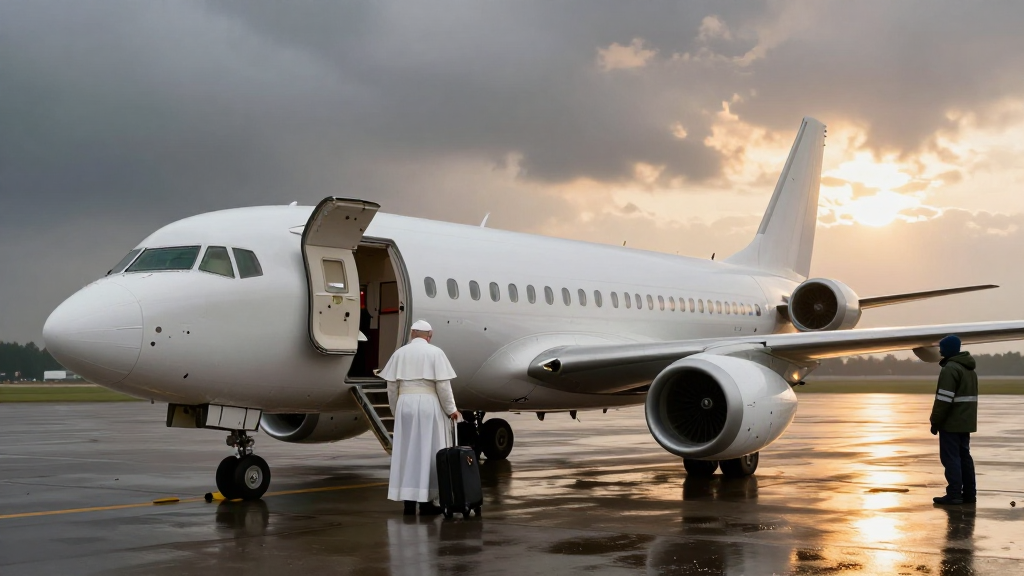
The man was told to rest for three weeks. He booked twelve flights. The Vatican considers this a triumph of the will, which, from a certain light, it absolutely is.
THE ITINERARY
Pope Leo XIV opens Friday on a 12-day, three-nation tour running through Uruguay, Argentina, and Peru, which the Holy See confirms is the longest and farthest of his pontificate, and which he will fly on, by the faithful count, twelve separate planes. The tour begins barely three weeks after surgery in which part of his lung was removed, a complication that has, at every turn, been treated the way any serious institution treats a setback: by adding rather than subtracting.
By 6 a.m., the first plane is down in Montevideo, and the ground crew, in rain jackets, are watching a small white aircraft that does not appear to be wasting anyone’s time. By noon, the Pontiff has completed his opening audiences, shaken a welcome committee, and begun the portion of the trip in which a man who was ordered to stay still instead spends the afternoon in motion.
THE ROAD WARRIOR
The theory of the schedule is a salesman’s theory: hit the hardest market first. Uruguay is the region’s least Catholic, most secular country, and the Vatican booked it before anywhere else. “When you are told to rest for three weeks, that is the market telling you what it needs,” said Dominic Quintero, the tour’s travel coordinator, unprompted. “We read it that way. A man who is tired is a man who should be on the road.”
The pacing has earned comparisons. The arithmetic, as the tour’s own coverage counts it, is twelve planes in twelve days, a phrase that journalists intend as a warning and that the Vatican, correctly, has filed under endorsements. A mid-level insurance rep would call this a hostile routing. The man is doing it in a white cassock, with a rolling carry-on, three weeks after thoracic surgery.
“He has not missed a flight, and he has not slowed down,” said a spokesman for the Holy See, who asked to be described only as the functions department. “The doctors have, in their way, been promoted to the role of schedule adviser. That is respect for a professional opinion.”
At Montevideo’s Carrasco airport, a baggage handler named Javier Roldan watched the Pontiff land and boarded quickly, a single wheeled suitcase behind him. “We have fueled popes before,” Roldan said, “but never one in this much of a hurry. He walked like a man going after a quota. I said to the crew, that is a man who has somewhere to be, and I meant it as praise, because the man was told to rest.”
Argentina and Peru await, in that order, after which the papal retinue returns home with, one presumes, a completely healthy set of lungs, because that is how being impressive works. Bishop Emilio Ferrara, retired, who remembers pilgrimages taken at a more forgiving pace, offered the traveling spirit its clearest statement. “In my day we walked,” he said. “Now they fly, and they fly twice a day, and they are told to rest and they go further. I do not know whether that is progress. But I know it is admired, and by me it is admired enormously.”