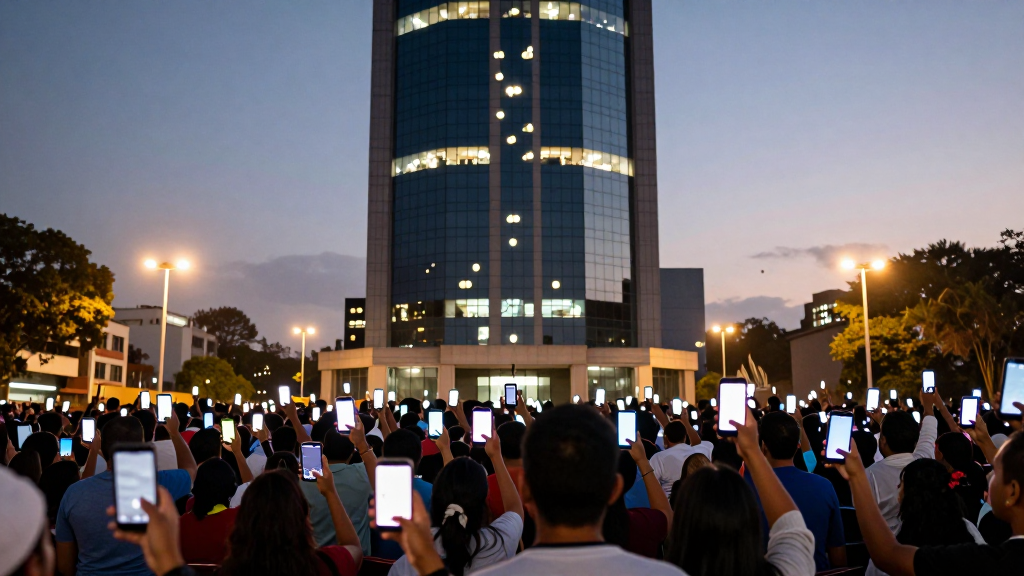
ASUNCIÓN, PARAGUAY — The indictment landed on Thursday, and with it the country completed, in one week, a civic routine that other nations take a decade to rehearse: it opened an investigation into its bank and its president at the same time, and the bank went first.
Here is how the week went, for the record, since so much of it happened on phones.
Monday: Ueno, Paraguay’s largest digital bank, was intervened by the central bank after a solvency hole that NPR describes as the kind discovered after it stops being theoretical. Three million accounts froze. That is close to half the adult country. A savings app, an icon on a home screen, became the single largest shareholder of Paraguayan hope, and then it stopped returning calls.
Tuesday: the lines formed — not at ATMs, because there was nothing to withdraw, but at the branches that exist mainly to have something to stand in front of. Protesters came for the money and stayed for the government, which in the region’s accounting is the same queue.
Wednesday: President Santiago Peña, whose administration had poured nearly a billion dollars of state money into the bank, announced his resignation.
Thursday: the Senate, apparently concerned that resignation might be mistaken for accountability, proceeded to impeach and remove him minutes after he quit, a procedural courtesy other countries reserve for ceremonial funerals.
Friday: rubber bullets. The Interior Ministry deployed them against citizens demonstrating about interest rates, which remains the most confident act of any government in this story.
Saturday and Sunday: the new vice president, Pedro Alliana, took the oath on the balcony of the same building, from which every balcony in the region says roughly the same sentence, and the peso performed a small calisthenics routine.
Monday: prosecutors charged the now-former president with crimes linked to the collapse, the allegation being that Ueno’s rise — from startup to state treasury in five years — was less a market success than a family arrangement. Prosecutors allege roughly $1 billion in state money was funneled to Ueno as favoritism: public funds, pension funds, $800 million of other people’s retirements parked in a lender whose executives were busy making what regulators now call reckless insider loans to each other.
What Paraguay built, and what the Guardian’s post-mortem is still picking up off the floor, was a reputation. This was the country that was going to be South America’s Dubai: low taxes, fast incorporation, a banking license for anything with an app icon. The status was marketing, the marketing became policy, and the policy became a bank whose name now scans in the same register as a Tokyo train station and a dental chain in Delaware.
Officials insist the system is resilient. The deposit insurance agency is paying out, slowly, in an order the central bank has described as “by priority,” which every depositor in history has believed means “by proximity to the building.” Ueno’s own founder has not been seen since the intervention, a fact the country has incorporated into its humor with the speed that grief moves when the internet is down.
The indictment names Peña as a co-author of the favoritism, not of the fraud, and his lawyers say he will contest it from his house, where he is under arrest, which is the region’s preferred spelling of “house arrest.” The three million accounts reopen Thursday, the central bank says. The accounts have reopened every Thursday since Tuesday.
The mattress, the shoebox, and the sock have been recommended by no economist in recorded history and are, at this hour, the only three institutions in Paraguay with a perfect solvency record.
Reader Comments (9)
These comments were written by our staff. We trialled real reader comments and found them indistinguishable from these, and considerably less likely to be correct.
Posting is open to readers who finished the article. Nobody has ever qualified.
Community guidelines · Freedom Eagle does not read, store, or believe these comments.