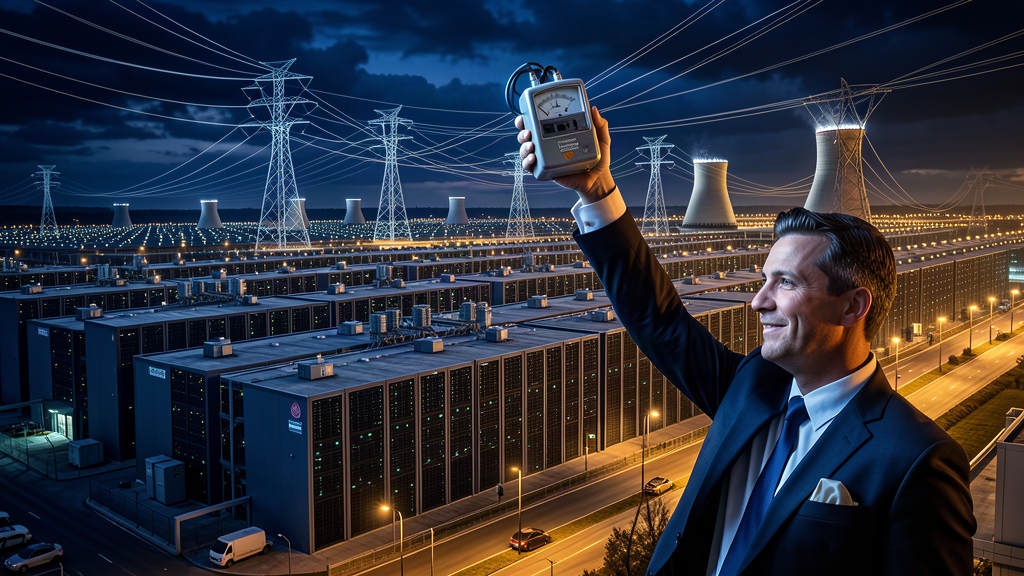
NEW YORK — There is now a market for the electricity that artificial intelligence eats, and it is, by the account of the people running the market, a $61 billion market.
That is the figure circulating this week as Wall Street continues packaging operating data centers, tenant contracts, and power infrastructure into bonds that are repaid, in the end, by the customer bills of the companies renting the machines, per coverage of the structure. The investor buys a slice of a building that is mostly a very expensive promise about electrons, and the electrons, when they arrive, pay the investor back.
The novelty is not the debt. It is what the debt is underwritten against. Commercial real estate has been underwritten against tenants, against location, against the general faith that someone will want to sit in an office. A data center deal, in the version the market is now pricing, is underwritten against megawatts — against the availability of power itself, which is to say the asset is partly a power plant and partly a real estate deal and partly a bet that the model inside it is still the model investors bought it for.
HOW A MEGAWATT BECOMES A BOND
- The asset: An operating data center, its tenants, and the power contract that keeps it humming
- The cash flow: The rent, plus the electricity the rent buys, which is to say the bill becomes the income statement
- The credit question: Who is the tenant, what is the power, and what happens if the model the tenant is running stops being the model the tenant is running
- The size: $61 billion and counting, which is a number the utilities are treating as a customer and the grid operators are treating as a line in the budget
Regulators have, in the spirit of the times, been accommodating. The SEC has clarified that bonds tied to physical data centers do not require certain post-crisis risk-retention protections, a decision that, in the words of one lawyer who does not represent anyone in this particular transaction, “lowers the cost of a deal whose underlying asset is a meter.”
Insurers are circling as well. Catastrophe-bond specialists say the most natural entry point for the space is a property tranche covering the risks their market already knows how to model — hurricanes and earthquakes — which is, for a building full of very expensive computers, a reassuring list, or a disturbing list, depending on which side of the Gulf of Mexico the server farm is on, per the coverage of the insurance angle.
At press time, the first wave of data-center securitizations was pricing, the utilities were updating their load forecasts, and one analyst had the market’s mood in a single line: the grid was built for a country that watched television, and the bonds are built for a country that does not.