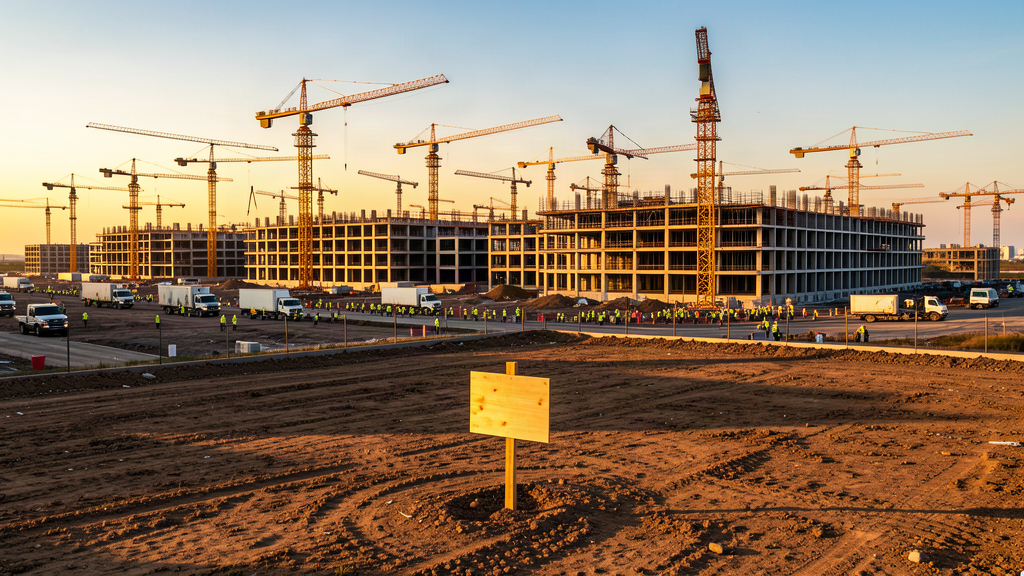
ARLINGTON, Va. — The American economy has, by most measures, never been healthier, and that is precisely the problem. The artificial intelligence boom is so powerful, so real, and so hungry for physical infrastructure that it has begun to absorb the construction labor force faster than the labor force can reproduce, leaving an increasing number of housing projects without anyone to build them.
Data centers are now carrying a meaningful share of U.S. construction spending, and the pipeline of announced projects has grown past a trillion dollars, according to industry figures. Contractors working on data centers are, by their own accounts, having the best year of their careers: backlogs are long, crews are large, and the pay is, in the words of one foreman, “absurd.”
The catch is that there is no more labor to go around.
“I can’t find a single electrician who wants to wire a house. They all want to wire a data center. I don’t blame them. The data center pays better and it’s indoors.”
The result is a paradox that economists have been circling for several weeks. The technology that is supposed to make everything more efficient is simultaneously the thing most likely to make it harder to build a new bathroom, because the people who build bathrooms have decided, rationally, to go work on the thing that will one day build their bathrooms for them.
A construction economist noted that the overall labor supply in the industry has been trending downward since the Great Recession, a long-standing problem that the data center boom has not so much solved as “dramatically amplified.” The same worker who would once have built a row of townhomes is now, in many cases, pouring the concrete foundation for a server facility that will process, among other things, the very demand that made the decision to leave the townhomes in the first place.
THE WORKER, BY THE NUMBERS
- Announced data center pipeline: over $1 trillion
- Share of construction spending now tied to data centers: rising
- Electricians available to wire a new house: "hard to find"
- Electricians available to wire a data center: "a lot"
- Houses left unbuilt as a result: too many to count, one economist said
The situation is not, industry officials stress, a sign that the AI boom is over. If anything, they said, it is a sign that the boom is working exactly as intended. The problem, in their framing, is not too much construction. The problem is that construction has, for the first time in a generation, become the scarce resource.
At press time, one major technology company had announced it was paying to train the next generation of data center workers, and a housing group had asked whether, perhaps, the two booms might share a crew. “We’re open to solutions,” the housing group said, before adding, “though the data center crew is not, at this point, open to them.”