The man who invests Harvard’s money does not give many interviews, and on Thursday he did not give one. He issued an annual financial report, a document that functions in the endowment world the way a trophy case functions in a den: it is not meant to be read, it is meant to be looked at.
The report, per CNBC, shows the university’s endowment grew 27.1 percent in the fiscal year, its best return in five years, bringing the pile to nearly $68 billion. The S&P 500 returned 22.3 percent over the same stretch. Harvard beat the market by 4.8 points, which is the financial equivalent of a man mentioning, casually, that he parked in the president’s spot.
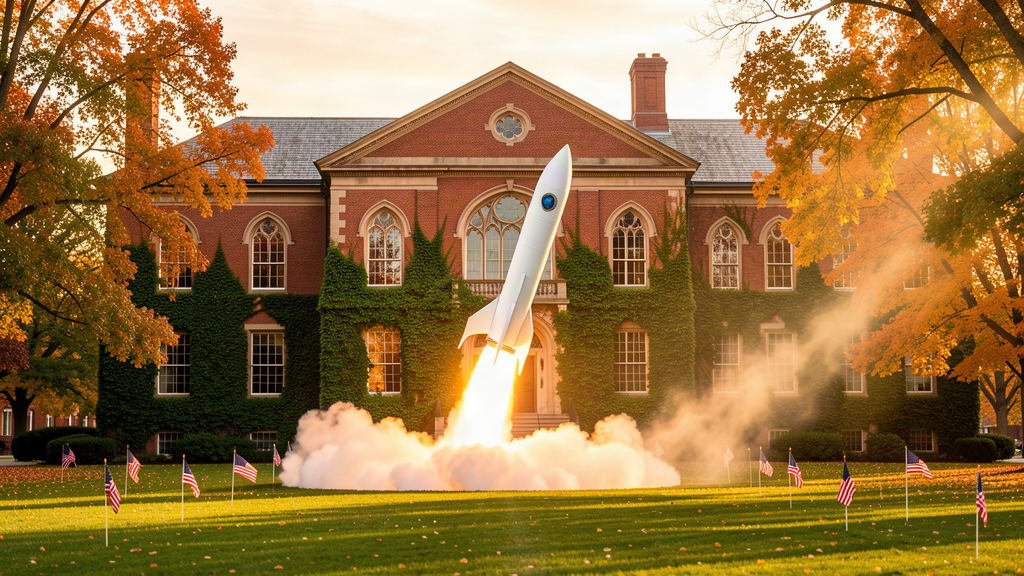
The single biggest reason is a $2.2 billion stake in SpaceX, the company that makes rockets, disclosed in a regulatory filing in the second quarter. The largest single holding of the most prestigious university in America is now a rocket company. The narrator finds this beautiful. For two centuries Harvard taught the children of privilege how to quote Virgil. It has now learned how to quote a launch window.
The endowment office, which manages the money, is a famously private operation housed in a glass building in the suburbs of Boston, staffed by people who are paid in the specific to be boring. Its public output is a PDF. Its private output is the largest rocket position in higher education. The office declined, as it always declines, to comment.
What is remarkable is the discipline. The endowment bought SpaceX when buying SpaceX was a hobby of billionaires and a punchline of venture capitalists. It held. It did not sell during the years when the rockets exploded, and it did not sell during the years when the rockets landed, and it did not sell during the years when the rockets became the most valuable private company on Earth, and it did not sell, one suspects, during the years when the founder of the rockets was on the cover of every magazine the endowment does not read.
The report also credits positions in artificial intelligence, including Nvidia and Cerebras. Harvard is now, in the specific, a semiconductor portfolio with a library attached.
There is a federal investment tax on large endowments, and it is scheduled to rise to 8 percent. Washington has spent years arguing that universities are liberal institutions living off unearned wealth. The tax is the answer to that argument. The narrator notes, in fairness to the left, that the tax is being paid by an institution whose top asset is a company whose founder, as of this writing, cannot go three days without being on the front page of a website that hates him. The right’s revenge on Harvard is a line item in Harvard’s favor.
The endowment office’s report runs to dozens of pages. The section on SpaceX is short. It does not need to be long. The number is the interview.
A university spokesperson said the returns “support the university’s academic mission.” The academic mission, as has been well-documented, includes the rockets.