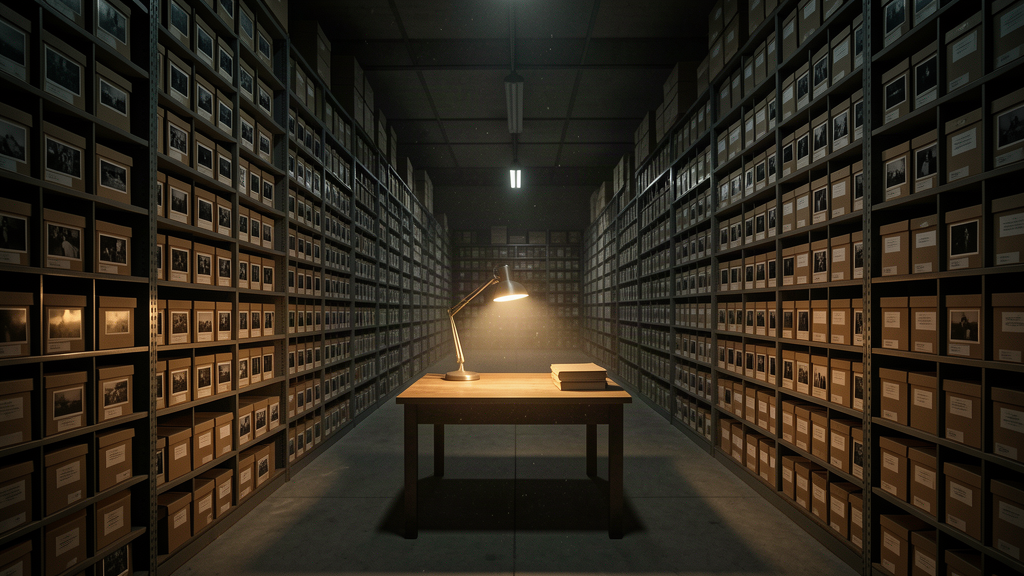
“We had every picture of everything.” That is how one former licensing executive described the Getty Images archive to this newspaper — 477 million photographs, illustrations, and clips, the visual memory of a century, filed and searchable and priced by the pixel. On Tuesday the company announced it intends to file for Chapter 11 bankruptcy protection, citing billions in debt following a collapsed $3.7 billion merger with its rival Shutterstock.
The company will call the filing a restructuring, and it will be one, the way a life raft is a boat. What actually happened is simpler and belongs in a museum next to the archive: the computers learned to draw.
For three decades Getty sold the world to itself. Two businessmen shaking hands. A woman laughing alone with a salad. A hand holding a light bulb, which is to say an idea, which is to say the moment before the light bulb company hires Getty to explain the light bulb. These images were not art. They were load-bearing infrastructure. Every quarterly earnings slide, every dentist’s waiting-room brochure, every local news graphic about a “kitchen fire” that was actually a woman laughing alone with a salad — all of it ran on Getty.
Then the image generators arrived, and they arrived with the specific American confidence of a machine that has never once needed a salad to look sad. Why license the handshake for $120 when you can generate a handshake for nothing, from a stranger, forever? That the generated handshake has seven fingers is, in the startup calculus, a detail — and details, as Getty has learned, are now a licensing opportunity.
The shuttered merger matters here too. Getty and Shutterstock were going to become one enormous picture of everything, which regulators apparently decided was too many pictures for one company to hold, a sentence nobody expected to read in this century. Abandoned mid-merger, holding debt like a stone in the chest, Getty now asks a bankruptcy court for what every American asks a bankruptcy court: more time, less debt, and the chance to explain the pivot to a room that has already left.
There is a consolation in this, and it is a grim one. The archive survives. Four hundred and seventy-seven million images of wars, weddings, elections, salads, and handshakes will not be deleted; they will be sold, licensed, or otherwise made productive, which is the American afterlife for things that were once beautiful and are now data. The photographers who made them, meanwhile, are learning what the taxi drivers learned and the travel agents learned before them: you can be the industry and the evidence of the industry’s passing in the same fiscal year.
At the warehouse in Seattle where the oldest negatives are stored, a night security guard — the kind of employee bankruptcy proceedings are always about to make unnecessary — described the collection the way people always describe it, which is that it doesn’t feel like an asset. It feels like a memory. He said the lights go off at ten. He said he leaves them on anyway.