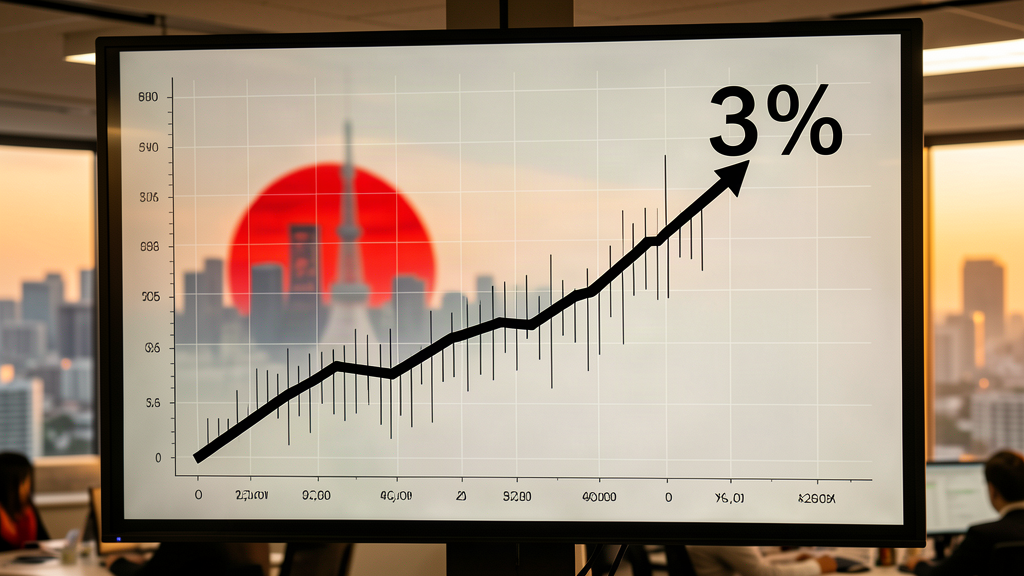
TOKYO — For thirty years, the yield on Japan’s benchmark 10-year government bond has not touched 3 percent, which is, for a country that spent the last three decades at roughly the rate of a slow blink, the number the entire market is now talking about. The number is now 3 percent, and the government that spent the last year asking its ministries for a record budget is, per one treasury official, “not surprised.”
The yield rose to the level for the first time since September of 1996, which is, for the market, a date that was, until this week, a thing you could only mention in a footnote. The footnote has now, per a strategist who has covered Japanese bonds for the better part of a career, “become the headline,” and the headline is, in the specific, 3 percent.
The driver, according to the people who have been naming drivers all week, is a budget. Japan’s ministries have requested a record amount of spending for next fiscal year, and the requests are set to swell to around 140 trillion yen, which is, for a budget, a number that comes with its own interest rate. Prime Minister Sanae Takaichi has described her fiscal ambitions as, in the words of the officials who carry the briefcase, “a priority,” which is the term the treasury uses when it means “the yield is watching.”
The market, which has spent the last month sending a message the government has described as “noted,” has now, at 3 percent, made the message a number. Debt-servicing costs in the current budget jumped to 31.3 trillion yen, the highest in 29 years, which is, for a line item, the kind of number that used to be a projection and is now, per one bond trader, “a schedule.” The market’s view of the spending is now a yield, and the yield is, for the first time in a generation, a headline.
The irony, which the treasury has not commented on because the treasury has, per a spokesperson, “a yield to defend,” is that the record budget is being financed by deficit bonds, and the deficit bonds are now priced at the level the country last saw when the 10-year was, in the words of one economist, “a different animal.” The animal, it turns out, is back, and the animal is 3 percent.
THE BUDGET AND THE BOND: THE SAME NUMBER, TWO WAYS
- The yield: 3 percent, first time since September 1996, which was, until this week, a footnote
- The budget: Record requests, swelling toward 140 trillion yen, a number that, per the treasury, "has a rate"
- The servicing cost: 31.3 trillion yen, the highest in 29 years, a line item that is now "a schedule"
- The financing: Deficit bonds, which are now priced at the level the country last saw "when the 10-year was a different animal"
- The government's view: "Without affecting the bond market," a phrase the bond market has, per the bond market, "received"
A Tokyo bond desk that has spent the last three decades pricing the 10-year at a level it would not, in 1996, have priced at 3 percent described the current market as “a market that has, in the specific, remembered.” “What we are pricing now,” the desk head said, “is not a budget. We are pricing a budget that is also a number, and the number, for the first time in thirty years, is 3.”
At press time, the yield was holding at 3 percent, the budget was, per the ministries, “still being requested,” and the treasury, which has been asked how it plans to implement the measure without affecting the bond market, had, as of this writing, “a yield to report.”