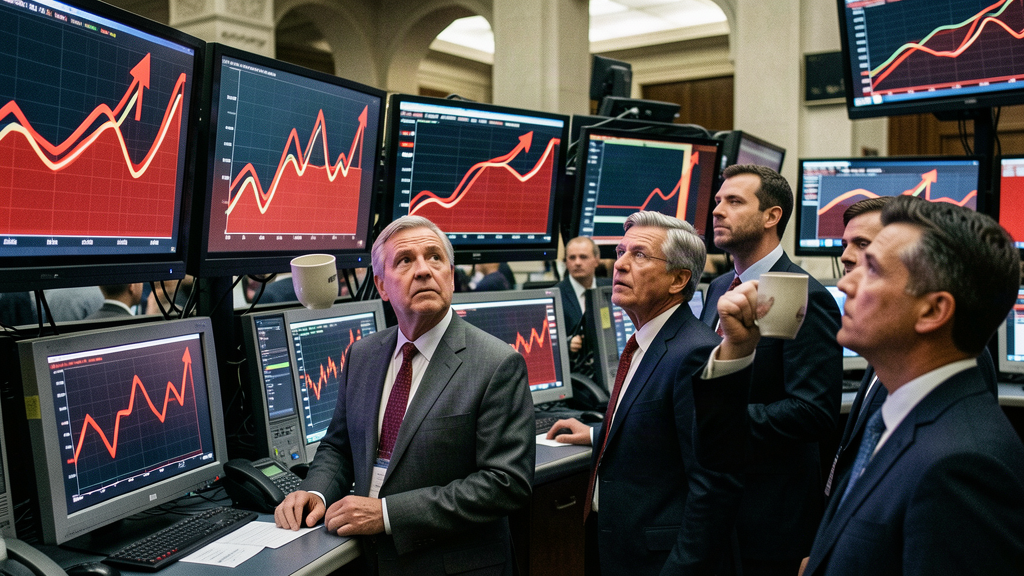
NEW YORK — The 10-year U.S. Treasury yield closed Monday at 5.24 percent, the highest level since 2007, a fact that has left bond traders jubilant, mortgage holders bewildered, and the Federal Reserve looking at its own rate-cutting schedule the way a man looks at a reservation he has already cancelled.
The number matters because the 10-year Treasury yield is, in the estimation of economists who have been asked to explain it on television, “kind of the rate for everything.” It is the rate your mortgage is based on. It is the rate corporate bonds are compared against. It is the rate that determines whether the government can borrow money without the market asking questions. And on Monday, it went through 5 percent like it had been there before, which, as traders were quick to point out, it has, and the market remembered.
The move was driven, in the assessment of several analysts, by a bond market that has been telling the Federal Reserve, for the better part of a year, that the inflation problem is not over, in a tone of voice that the Fed has described, in one leaked internal memo, as “aggressive but polite.” The market’s position, summarized by one fixed-income strategist, is that the Fed is going to have to raise rates, not cut them, and that the market is “not mad, just disappointed,” which is the bond-market equivalent of a very calm voice.
"The market is not mad. It's just disappointed."
For the average American, the news lands in two directions at once. The good direction: if you hold a 10-year Treasury bond bought at 5.24 percent, you are beating inflation, which is something that was not available to you last spring when the yield was under 4 percent and the savings account was performing what one bank’s website called “the quiet kind of growth.” The bad direction: the same rate is what your next mortgage, your next car loan, and your next anything with the word “fixed” in it is now priced against.
Gold, for its part, fell 3.7 percent to $4,127 an ounce, which analysts described as a “rotation,” by which they meant that people who had been hiding their wealth in gold were, for reasons best known to gold, moving it into Treasuries, which is a thing people do when they believe the government will be around in ten years to pay them back, which is a belief the bond market apparently holds with a confidence the rest of us have not had the chance to examine up close.
The Fed, when asked for comment, declined to comment. The bond market, when asked the same question, moved another 4 basis points, which is the closest the bond market comes to a shrug.
WHAT 5.24% ACTUALLY BUYS YOU
- A 10-year Treasury bond: $100,000 invested becomes roughly $167,000, assuming the government is still a government in ten years
- A 30-year fixed mortgage: the "affordable" rate, in the estimation of every mortgage broker in the country
- A savings account: 5.24% is the rate the bond market is offering; your bank is offering less, on purpose, because banks are not the bond market
- A corporate bond: the rate a company can borrow at, which is the rate the market thinks the company is, in the words of one credit analyst, "a responsible borrower"
At press time, the 10-year yield was at 5.24 percent, the 30-year was at 5.56 percent, and the 1-year was at 4.53 percent, which means the yield curve is upright, which means the market does not think there is a recession in the next year, which is either a good sign or a very confident sign, depending on which of the last several years you are using as your baseline. The Fed’s next meeting is in three weeks. The bond market has already made its decision. It is, in the words of one trader, “just waiting for the Fed to read the room.”