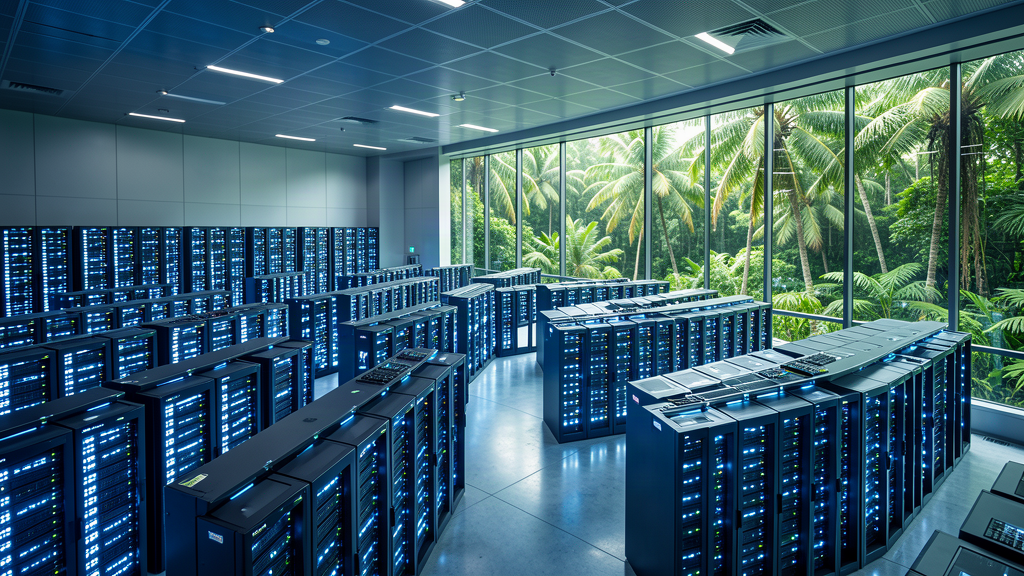
KUALA LUMPUR, Malaysia — There is a country in Southeast Asia that has quietly become the most important address in computing, and it has done so with a strategy so simple that economists keep re-reading the memo to make sure no one is joking.
Malaysia is building data centers. Not a few. Data center investment now accounts for roughly 18 percent of the country’s entire GDP — the highest share in the world, against the one-to-five percent range most economies manage. The country hosts an estimated 60 percent of all proposed data-center projects in Southeast Asia, and it is growing at six percent a quarter on the strength of it.
Here is what that means in plain terms, because the number is so large it stops meaning anything at 18: for every hundred dollars Malaysia earns, eighteen of them arrive because somebody, somewhere, needed a place to put a computer that never stops.
1. The Americans provide the computers. The hyperscale giants — the companies whose names are one syllable and whose earnings calls move currencies — needed somewhere to put the machines that run their language models, their videos of cats, and their arguments about politics. Malaysia said: here.
2. The Malaysians provide the rooms, the power, and the paperwork. And then, as the central bank’s own analysts point out, the suppliers followed: the makers of server racks, modular cooling units, and prefabricated everything moved their factories in, because factories follow rooms.
3. Everyone gets what they wanted, and the narrator wants to pause on this. The American companies get cheap, stable, tropical rooms. Malaysia gets factories, jobs, growth, and a seat at the table of every technology conversation on Earth. The Malaysians have a plan to be “an AI nation by 2030,” and they are pursuing it with the specific energy of a people who read the plan and started pouring concrete.
That is the whole strategy. It is printed on no posters. It requires no task force. It has one sentence.
The irony, which the narrator refuses to call irony because the word implies a problem, is that the most consequential technology construction project of the decade is happening in a country that mostly builds it for other countries. The servers in Johor answer questions in Ohio. The models trained in Penang write emails in Phoenix. Malaysia’s eighteen percent is, in a very real accounting sense, America’s AI bill, paid to a landlord who brought coffee.
The Malaysians are not upset about this arrangement. They are expanding it.
The American companies are not upset about it either. Their quarterly numbers, which are the closest thing to a national mood indicator the industry has, are the sound of people who found a landlord.
The rooms go up. The computers go in. The jungle stays outside the window, on the other side of the glass, at exactly the distance everyone agreed to.