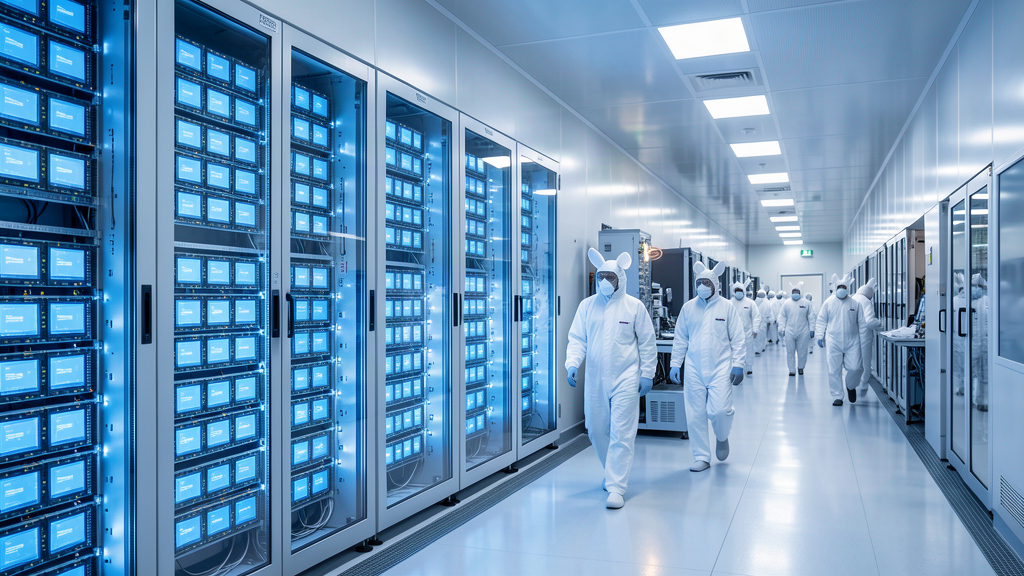
SEOUL — Samsung Electronics announced Thursday that it earned an operating profit of 107.4 trillion won — roughly $80 billion — in a single quarter, the highest quarterly profit any technology company has ever recorded, a figure achieved by making the small memory chips that artificial intelligence needs in order to pretend it thought of something.
Investors, upon hearing the news, sold the stock, and they were right to. The number was $80 billion. The expectation, in the specific, was $81 billion. When a company earns the gross domestic product of a mid-sized European country in ninety days and the market responds with a shrug and a red arrow, what you are witnessing is not greed. It is ambition at a scale the human race has not yet agreed to celebrate.
The profit came almost entirely from high-bandwidth memory — the stacked chips that data centers buy in such quantities that the company’s own executives have begun describing the demand as “relentless,” a word normally reserved for weather and lawsuits. The AI boom has swung the entire memory market in Samsung’s favor, along with its rivals SK Hynix and Micron, whose combined fortunes now rest on a product almost no consumer has ever held, seen, or pronounced correctly.
The company’s shares slipped precisely because the record was not the point. The point is the next record. This is the bargain the market has struck with the AI economy: every quarter must be larger than the quarter before, forever, and any quarter that merely makes history will be punished for not also making the future. Samsung beat its own estimates. The estimates then beat the estimates. Somewhere, a spreadsheet updated itself and called it guidance.
SAMSUNG’S QUARTER, IN NUMBERS THAT FEEL WRONG
- Operating profit: 107.4 trillion won, about $80.2 billion, first time past 100 trillion
- Growth: up nearly ninefold from the same quarter last year
- Star product: high-bandwidth memory, a chip you cannot buy separately, hear about constantly, or afford
- Stock reaction: down, because $80 billion was $1 billion short of the fantasy
Economists note that the windfall has already reshaped the Korean economy, funded a shareholder return program of unprecedented size, and made one company’s quarterly earnings larger than the annual budgets of most governments. Others note that the same chips sit inside data centers whose electricity bill is arriving slowly, like a tide with an invoice.
At press time, Samsung had announced it expected next quarter to be bigger, and the internet had responded, as it always does, by asking whether the chips would be available in a smaller size for phones.