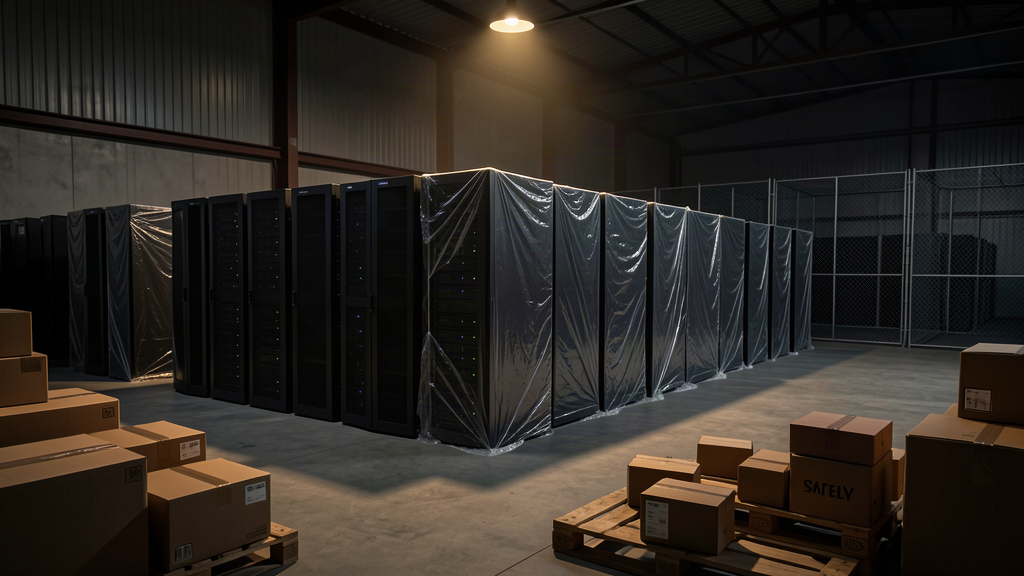
The most powerful collection of artificial intelligence on Earth is currently in storage, under plastic, like a boat somebody’s uncle is fixing.
Amazon bought billions of dollars of new Nvidia AI server racks this year and had nowhere to plug them in. Internal emails describe $5 billion of systems arriving in August and being staged in warehouses, with roughly $3 billion more expected every month, while the data centers that are supposed to house them wait on electricity. The company is not alone. It is just the clearest photograph.
The bottleneck is no longer chips, or money, or demand. The bottleneck is a man named Dale Prochak.
Prochak is deputy director of interconnection queues at a mid-Atlantic utility, which means he decides, in order, who gets to attach their project to the electric grid. The folding desk is real. The calendar is real. The list on the calendar is four years long. Amazon — a company that delivers a small nation’s worth of packages per day — is number fourteen on a page.
Prochak’s morning begins at 6:40 with coffee and the applications: folders two feet thick from solar farms, battery plants, and data centers, each one requesting a connection and each one aware, before it arrives, that the answer is “sequenced.” His department does not say no. His department says “after.” A large solar-plus-storage project may wait half a decade for a queue position. A data center campus may wait seven years for the substation it assumes already exists. The transformers that make the whole thing work are on order two years out, in a queue that has its own queue.
The industry has stopped pretending this is temporary. Morgan Stanley now expects U.S. data centers to face a roughly 32-gigawatt power shortfall through 2028 — about a third of what the AI buildout is asking for — after revising demand upward by 43 percent in a single year. Consulting firms say more than half of new AI servers built in the next few years may have no powered building to stand in. The chips, in other words, are ready for America. America’s wiring is scheduled.
The Queue, at a Glance
- Standard wait for a grid connection: three to five years. Walk-ins are not accepted.
- Large substations: up to seven years to permit and build. The neighborhood association gets a vote.
- Power transformers: on backorder for years, from suppliers who apologize without changing dates.
- Server racks: already built, already paid for, already climate-stored, awaiting all of the above.
None of this has slowed the spending. The warehouses are full because the purchases continue, and the purchases continue because the companies have concluded that a rack in storage is still an option, and an option is worth billions when everyone else is fighting over the same outlets. The AI race, at its leading edge, now resembles nothing so much as a road trip where every car is fantastic and the gas stations are under study.
The warehouse racks are kept at sixty-eight degrees, fully paid for, waiting on dates.
Prochak, reached at his desk between hearings on three separate battery projects, was asked whether America has enough power.
“Of course we have power,” he said. “We have it in a different place than the computers, and moving it is a nine-year project with public comment periods. The good news is that the comment periods are going very well.”