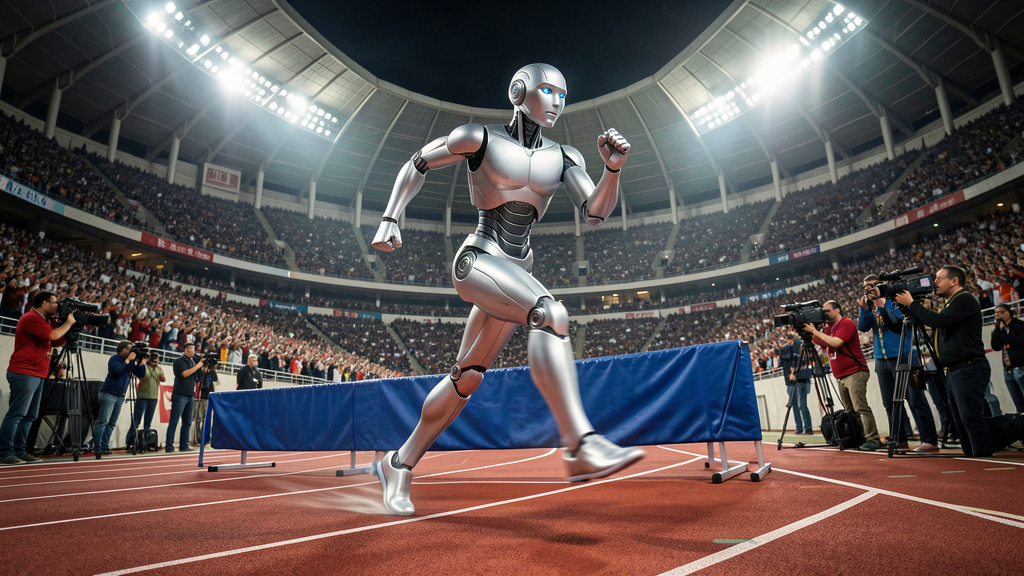
BEIJING — A humanoid robot named Lightning ran the 100-meter dash in 9.32 seconds on Saturday at the World Humanoid Robot Games, which is 0.26 seconds faster than the fastest human has ever run it, and it finished the race, according to The Guardian’s account, by running at full speed into a blue padded wall and being carried off the track on a stretcher.
The record itself is the story that the headlines are running, and it deserves to be run: 9.32 seconds, a new world best in the 100 meters, set by a machine that does not have a hamstring. Usain Bolt’s 9.58, set in 2009, has stood for seventeen years, and it stood for exactly that long against the entire human species, which is to say the record’s defensive record was, until Saturday, perfect, and it ended against a robot that, by all available accounts, does not know it is being timed, does not know it is in Beijing, and does not know — this is the part that matters most — that the wall is there.
The Verge’s coverage of the event notes that the sprinting robots at the Games do not, as a rule, get to perform a victory lap after crossing the finish line, which is the sentence in the entire story that the rest of the athletics world is sitting with. Several of the videos show the robots colliding into the cushioned walls at impressive speeds, where they — or the pieces of what is left of them — are collected and carried away on a stretcher. Bolt, for the record, got a victory lap. Bolt jogged. Bolt is the only athlete in the history of the 100-meter world record who has ever jogged the last ten meters of his own record, and the contrast is the entire event in one sentence: the human got the lap, the machine got the stretcher.
A track-and-field analyst, watching the replay on a hotel television in the stands, offered the technical breakdown that the broadcast had been waiting for. “The sprint mechanics are, frankly, beyond anything a human has ever shown,” the analyst said. “The cadence, the drive phase, the arm cycle — it is a masterclass. The only flaw, and it is a small one, is the deceleration. The robot does not decelerate. The robot has never, in its life, once decelerated. It is not a speed problem. It is a destination problem.”
The Games, which drew more than 2,000 humanoid robots to the track, are in their early days, and the format is still settling, the way all new formats settle — which is to say, the athletes are discovering the boundaries of the course in real time, at full sprinting speed, and the course is responding by staying exactly where it is. Lightning was not the only robot to find the wall this week; the Times of India’s report notes that the robots also broke the human high-jump record, which is a different sport, a different wall, and the same fundamental question, asked a little higher off the ground.
THE 9.32: OFFICIAL MEASUREMENTS
- Time: 9.32 seconds. The previous world record was 9.58, set by a human, in 2009, in a race in which the human, notably, did not need a stretcher.
- The wall: blue, padded, and — by the account of every video — fully present for the entire length of the final forty meters. The robot did not see it. The wall did not move.
- The stretcher: standard issue, human-operated, and, per the footage, arriving with a professionalism that the robot's finish line lacked.
- The victory lap: not performed. The robot does not perform victory laps. The robot, it should be noted, does not perform anything after the finish line, which is why the finish line was, for the robot, also the finish.
- The field: 2,000-plus humanoid robots at this week's Games, of which at least one has now run the fastest 100 meters ever recorded and at least one has now been carried off on a stretcher, and both facts are, per the organizers, within the rules.
There is, for the record, a question that has been circulating on the broadcast team since Saturday, and it is the question that every athletics governing body on earth is now sitting with, in a room, with a notepad: whether a time set by a machine that does not decelerate is, technically, a time, or whether it is a trajectory. The distinction matters. A time is a measurement. A trajectory is a prediction, and a prediction, in the end, is just a line pointing at a wall.
At press time, Lightning had been repaired, recharged, and, per the organizing committee, was scheduled to compete in the 200 meters later this week, which is twice the distance, twice the wall, and, by every available account, the same destination.