By Monday morning, the Portuguese Football Federation had reached a decision that legal scholars will be studying for generations, and it went like this.
First, the facts arrived. On October 1, Cristiano Ronaldo, 41 years old and the most famous athlete alive, walked out of Portugal’s national team camp on the eve of a Nations League match against Denmark, after spending an entire previous match warming up on the sideline without being put in the game. That night he posted a long statement to his 679 million Instagram followers, accusing manager Jorge Jesus of twice “breaking his word” and committing an “absolute breach of trust” — phrasing that belongs in a divorce court and performed beautifully in a soccer one. On October 10 the federation suspended him provisionally.
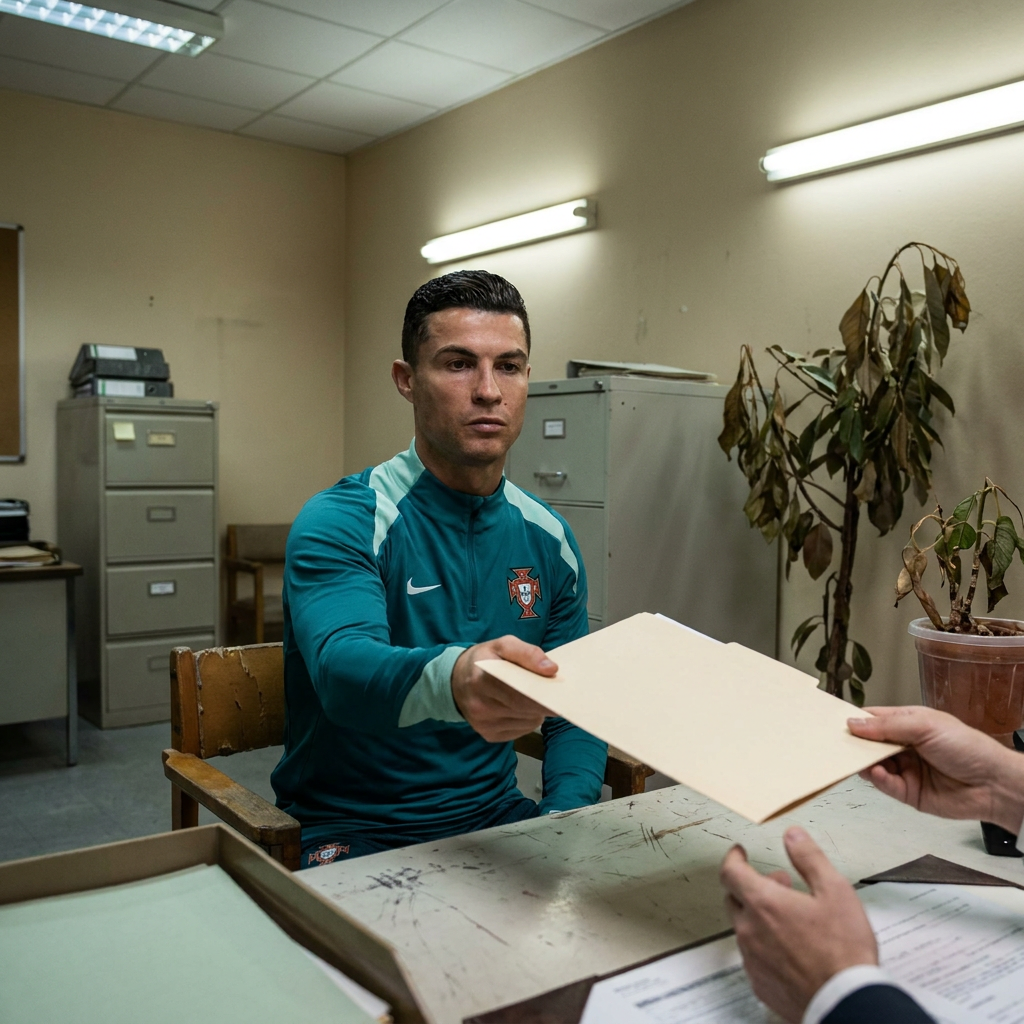
Then, over the following weeks, Ronaldo did something no player of his stature has ever done before a sports tribunal: he submitted a written defense, roughly 2,000 words, along with his CV. A résumé. To the association. Five World Cups, five Ballons d’Or, more official goals than any human being in the history of the sport, formatted, presumably, with a photograph.
By Monday, the federation had ruled. The punishment for walking out of a national team, for trying it publicly with a quarter-billion witnesses, and for the whole ugly business is a suspension of thirty days and a fine of €255. Two hundred and fifty-five euros, the price of a nice dinner for two in London, roughly forty seconds of his reported salary at his Saudi club. The suspension will cause him to miss zero Portugal matches, because there are no Portugal matches inside the thirty days. It has, in other words, the exact force of a parking ticket issued to a cloud.
The federation said it had “considered” the defense and the CV. Considered them. Somewhere in Lisbon, a disciplinary committee read two thousand words from the greatest scorer in the history of international soccer and then, with the calm of a landlord explaining a lease clause, fined him the price of a steak and suspended him through a stretch of calendar containing no games.
Lisbon bar owner Rui Castanho, whose television had the tribunal on all afternoon, offered the customers’ view: “We have wanted to see this man punished since 2004. They fined him the price of two bifanas and a beer. I am not angry. I am confused, which is worse.” A mother outside the federation building told reporters she thought the punishment was “very fair, God bless him,” which everyone agreed was the most frightening sentence of the day.
THE PUNISHMENT, ITEMIZED
- Suspension: 30 days
- Matches actually missed: zero
- Fine: €255, about $286
- Written defense: approximately 2,000 words
- CV: submitted, presumably excellent
- Appeal: none. There was nothing left to appeal.
Football has produced many great punishments — points deductions, empty stadiums, the eight-year ban on Italian clubs from European competition — but none has ever achieved this level of nothing. The federation wished to be firm and factual at once, and it found the only number that satisfied both: thirty days of calendar that contains nothing, for a man whose salary makes €255 a rounding error with opinions.
Ronaldo has not appealed. The résumé, per everyone involved, had already done its work.