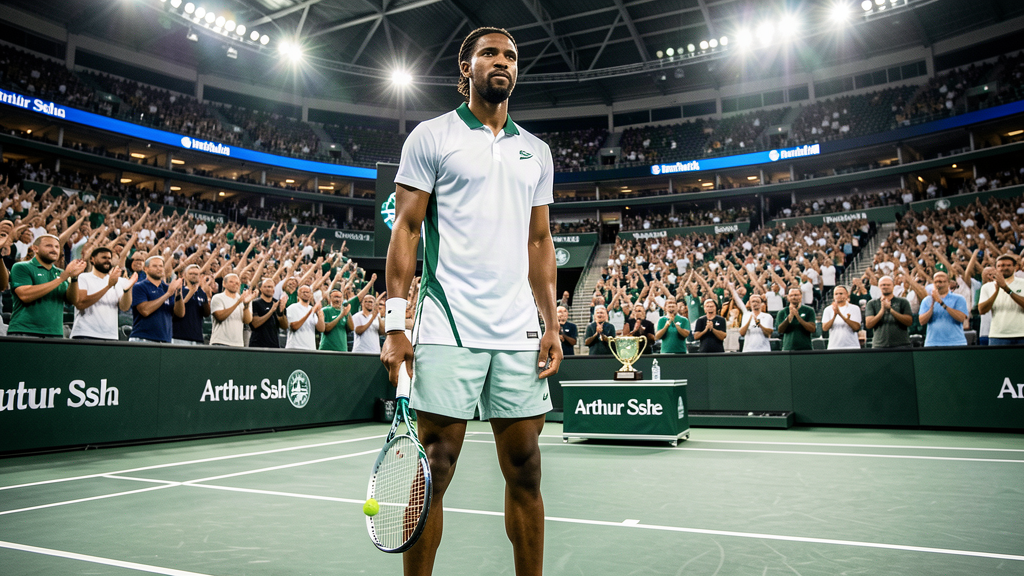
NEW YORK — Alexander Zverev has won the U.S. Open, beating Ben Shelton 6-3, 7-6, 5-7, 6-2 on Sunday to take his second Grand Slam title of the year, and the story of the match, by the account of the people who were there, was not the four sets.
The story of the match was the last three seconds.
After hitting what proved to be the final serve winner of the tournament, Zverev — a 29-year-old who has now played five Grand Slam finals and is wired, by the account of his coaching team, for a specific amount of drama — dropped back behind the baseline as if setting to receive, and stood there, in the center of Arthur Ashe Stadium, with the championship still attached to the other end of the net, per the match reporting.
He thought it was 5-1.
The scoreboard, as is its way, had already done the arithmetic. The crowd, as is its way, had already committed to the noise. And Zverev, as is his way, had done the one thing a German man of his generation has apparently never been trained to do, which is accept the result of a point he hit at 120 miles per hour and then immediately walk past it.
He did, in the end, figure it out. He raised his arms. He accepted the Tiffany & Co. trophy from Jimmy Connors, who was, for the occasion, holding it, and he accepted the $5.5 million, which he was, by the account of the people watching, handling with the same energy as a man accepting a luggage tag.
THE FINAL, AS THE SCOREBOARD SAW IT
- Sets: 6-3, 7-6 (7-2), 5-7, 6-2 — the second set a tiebreak, the third set Shelton's, the fourth set, per one analyst, "the part where it stopped being a match"
- The American dream, per the scoreboard: Shelton, 23, first Grand Slam final, and the country's best hope for the next one, who left with a line about gifts that the network aired three times
- The German record: Two Grand Slam titles in three months — Roland Garros in June, New York in September — which is a pace the country is, per the coverage, "gently getting used to"
- The final point: A serve winner, a drop back, and approximately three seconds in which the champion was, technically, a player who had just hit a good serve
Shelton, for his part, did the thing young Americans do, which is leave a final with a line. “My successes are a gift, the failures are a gift, and being here playing in front of you guys is a gift,” he said, which is the kind of sentence that will be in the postgame show for at least a decade and that Zverev, in the mixed zone, was heard to describe as “very American, in the good way, in the way I respect.”
Zverev did the thing tall Germans do, which is quote his mother. On a diagnosis at age four, and on the decision to keep playing: “If he wants to be a tennis player, he’ll be a tennis player,” he said, quoting her. “My mother is the most important and strongest person I know,” he said, which is the sentence the German paper will run tomorrow with a photo of the trophy and no photo of the moment at the baseline, because that moment, per the tour’s own feed, is the one where the winner is standing at receive position holding a 5.5 million dollar championship like a warm-up.
At press time, the trophy was in a case, the case was in a car, and Zverev was, per the team, “processing,” which is the tennis term for a man who still thinks it is 5-1 and is, in the specific, being gently corrected by everyone in the building.