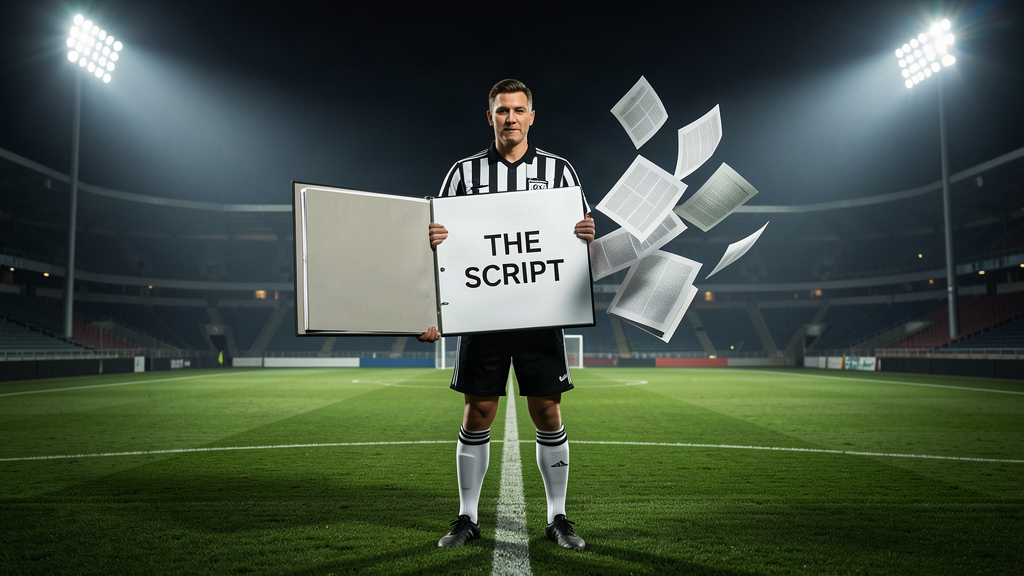
There was no huddle. There was no booth review. There was only the flag, arcing in with the confidence of a man who had read ahead.
With the game tied at 17 and 2:40 remaining Sunday in Detroit, Jared Goff dropped back, launched an 18-yard pass to Sam LaPorta, and Green Bay defensive tackle Karl Brooks arrived a half-second late to the party. The flag found Brooks for roughing the passer, the penalty moved the Lions into field-goal range, and Detroit won 20-17 on the kick that followed. By Sunday night, Green Bay fans had settled on three sentences, which they have been repeating at the league, at the broadcast booth, and at each other ever since: it wasn’t in the script.
That phrase is doing a lot of work, so it seemed fair to ask the man in charge of it.
The National Football League’s Office of Narrative Continuity occupies three windowless rooms on the fourteenth floor of the league office. Its staff of eleven maintains the script — the running document, updated weekly, that determines which games have late drama, which coaches get sympathetic press conferences, and which towns spend Tuesday explaining themselves. Its vice president, Dale Whitmore, has held the job nineteen years and considers it public service.
“People think chaos wins football games,” Whitmore said, tapping a binder the width of a folding chair. “Chaos wins two weeks. The script wins February.”
According to Whitmore, the Packers-Lions page went in on Thursday and read, in full: tie game, late flag on the big defensive tackle, home team wins on a kick, national argument in the morning, Packers coach says the quiet part out loud at his presser. Every beat landed on schedule. Matt LaFleur spent ninety seconds biting his tongue and then let it go, exactly as drafted. The only note Whitmore’s office filed was procedural: the no-call earlier in the game — Brian Branch’s helmet into Tucker Kraft’s facemask, Kraft’s helmet off, no flag — was written as a two-sided page, and Whitmore insists his people called it honestly in both directions.
The one loose thread was the television booth. Tom Brady, watching from the Fox desk, said things the script does not account for, because the script has never contained a former player angry at officiating; Whitmore’s staff logged the moment as an improv and moved on.
Asked directly whether the NFL possesses the document he describes, Whitmore smiled the smile of a stage manager and said his office neither confirms nor denies the existence of what his office is visibly holding.
At press time, the league had confirmed there is no script because there is no script, and had separately declined to answer questions about the binder, which Whitmore carried out of the building himself, in a bag clearly labeled equipment.