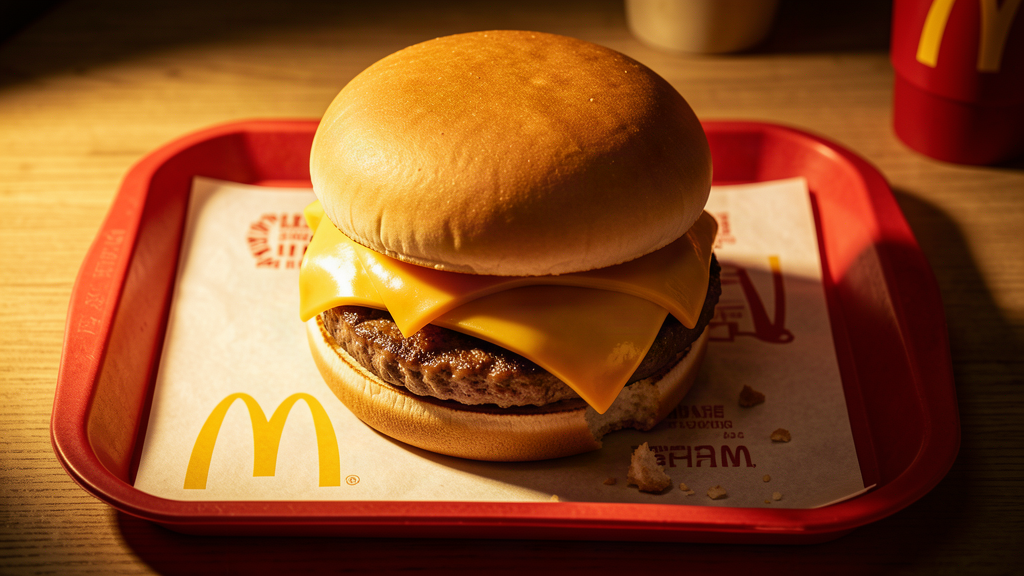
CHICAGO — In a moment that has been replayed approximately 47 million times on social media and analyzed with the rigor usually reserved for the Zapruder film, McDonald’s CEO Chris Kempczinski posted a video to Instagram in which he took a single, cautious nibble of the company’s new Big Arch burger and then held it up to the camera to reveal a missing corner so small it could be described as a “proof of concept” rather than a “bite.”
“That’s a big bite for a Big Arch,” Kempczinski declared in the video, which was posted on February 3, 2026, and which the internet has been measuring, mocking, and memeing ever since. The New York Times, which typically reserves its longform features for wars, elections, and the occasional celebrity profile, ran a piece titled “C.E.O. Takes a Big Bite Out of a Burger. Maybe Scratch ‘Big.’” which was widely regarded as the most devastating restaurant review in the paper’s 175-year history.
The video resurfaced this week as part of a broader conversation about the state of American fast food, which can be summarized as follows: Americans are eating less of it, paying more for it, and watching their CEOs nibble at it like it might be radioactive. According to The Economist, quick-service restaurant traffic fell 1.3% in the first seven months of 2026, and McDonald’s US sales grew just 0.8% last quarter — a number that would be impressive for a lemonade stand but is, for the world’s largest fast food chain, roughly equivalent to “the building is on fire but the fire is small.”
The Big Arch, for the uninitiated, is McDonald’s answer to the question “what if we made a burger so big that the CEO himself is afraid to eat it?” The burger features two beef patties, two slices of cheese, pickles, onions, and a special “Big Arch sauce” — a condiment whose ingredients are listed on the company website but whose taste profile has been described by food reviewers as “mayonnaise that went to grad school.” The burger retails for approximately $7.99, which is a lot of money for a sandwich that the CEO won’t commit to finishing.
The video’s enduring appeal lies not in the bite itself — which was, by any objective measure, a perfectly normal amount of burger to eat — but in the way it was presented. Kempczinski held the burger up like a trophy, smiled with the confidence of a man who has never questioned a marketing decision, and declared the nibble a “big bite” with the same conviction that a weatherman uses to predict sunshine during a hurricane. The internet, as the internet does, noticed the disconnect.
THE BIG ARCH: A TASTE TEST
- $7.99 — retail price (before tax, tip, and existential dread)
- 2 — beef patties (twice the beef, twice the regret)
- 2 — slices of cheese (the minimum required to qualify as a "burger" rather than "a sandwich with ambitions")
- 1 — "Big Arch sauce" (mayonnaise that went to grad school)
- 0.3 — inches of burger consumed in the CEO's "big bite"
- 47M — approximate times the video has been replayed on social media
- 1 — New York Times feature article about the bite (headline: devastating)
The fast food industry’s broader crisis is not about one video of one CEO eating one burger. It’s about a fundamental shift in American eating habits that the industry has been slow to recognize and slower to address. Consumers are increasingly choosing fast-casual restaurants — Chipotle, Sweetgreen, the place down the street that sells grain bowls for $16 — over traditional fast food, not because the food is better (it’s fine, not great) but because the experience feels less like a surrender.
McDonald’s has responded to the trend by doing what McDonald’s always does: introducing new products, launching marketing campaigns, and hoping that the combination of nostalgia, convenience, and a sufficiently large Coca-Cola will bring people back. The Big Arch is the latest iteration of this strategy, and the CEO’s viral video is, depending on your perspective, either a brilliant piece of accidental marketing or a cautionary tale about what happens when you let a businessman near a camera and a burger.
The most poignant detail in the whole saga may be the simplest one: Kempczinski took the bite, held up the burger, and said “That’s a big bite for a Big Arch” — as if the words themselves could make the bite bigger. In a sense, they did. The internet has been talking about it for six months. The New York Times wrote a 3,000-word feature about it. The stock dropped 12% this year. All for three-quarters of an inch of beef that the CEO of a $200 billion company couldn’t bring himself to finish on camera.
At press time, a spokesperson for McDonald’s had issued a statement clarifying that “Chris Kempczinski loves our food” and that “the video was intended to show his genuine enthusiasm for the Big Arch,” which is the kind of statement that technically answers the question and emotionally satisfies no one.