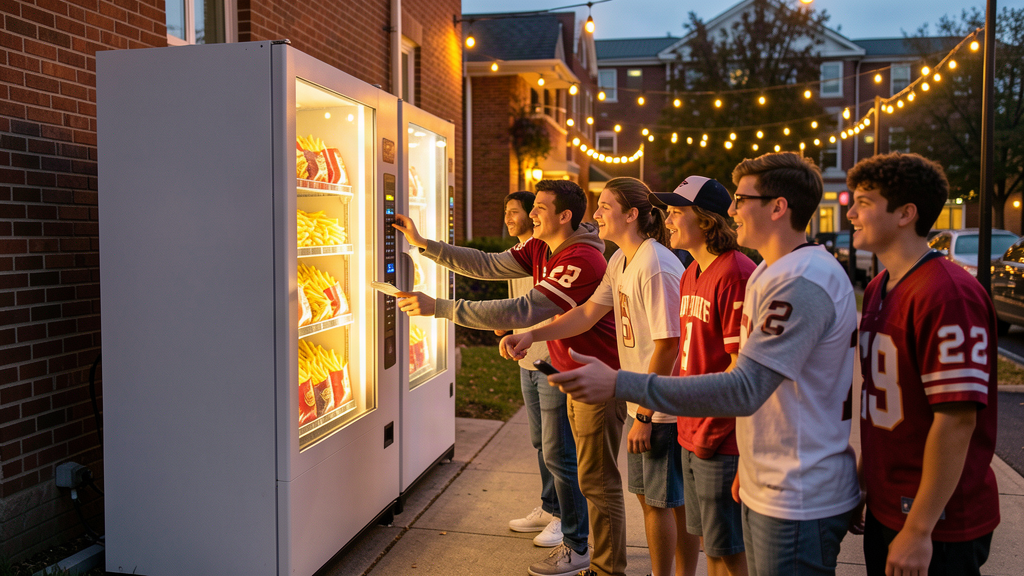
The machine arrived at 7 a.m. on a Saturday, plugged itself into the side of a building near LSU’s campus, and began handing out french fries to the walking wounded.
It is called Fry Aid, and it is, by McDonald’s own description, a “pop-up experience” — a vending machine the size of a phone booth, loaded with gift cards and bags of fries, set up outside a college party to serve students who have made choices. The company is running it in three cities at once — the fast-food equivalent of a triage unit.
The premise is simple and beautiful: a college student, after Homecoming, is a person who has lost something. McDonald’s has the thing they lost, and the machine is the bridge between those two facts.
“I been walking for like twenty minutes and this thing just appears, glowing, like a god,” said Jalen T., a sophomore who declined to give a last name “for legal reasons I don’t fully understand.” He took two bags. He ate both. He then, on his own initiative, took a third “for a friend who’s not here, he’s asleep, he doesn’t know he has fries now.”
The machine has no screen, no app, no login. It accepts a hand and returns a fry. In an age of fourteen-step digital transactions, the Fry Aid machine is the most advanced technology on campus.
FRY AID: THE SCIENCE OF THE MORNING-AFTER FRY
- Optimal serving temperature: "hot," per the company, a scientific term
- Most requested add-on: ketchup, requested by 100% of students, per the machine, which keeps score
- Peak hunger window: 11 a.m.–2 p.m., the hours a college student is legally considered a survivor
- Side effects: fries on the floor, a sudden belief in McDonald's, one student photographing the machine with his whole body
A McDonald’s spokesperson said the company wanted to “meet students where they are,” which, on a Saturday after Homecoming, is on a sidewalk, in the sun, in a costume, holding a fry.
The company confirmed the machines will be removed at the end of the weekend and returned to a warehouse, where they will sit in the dark, fully loaded, dreaming of the next party.
A university spokesperson said the school “appreciates the gesture” and “encourages responsible consumption,” a sentence that has never once been read by a person who was consuming.