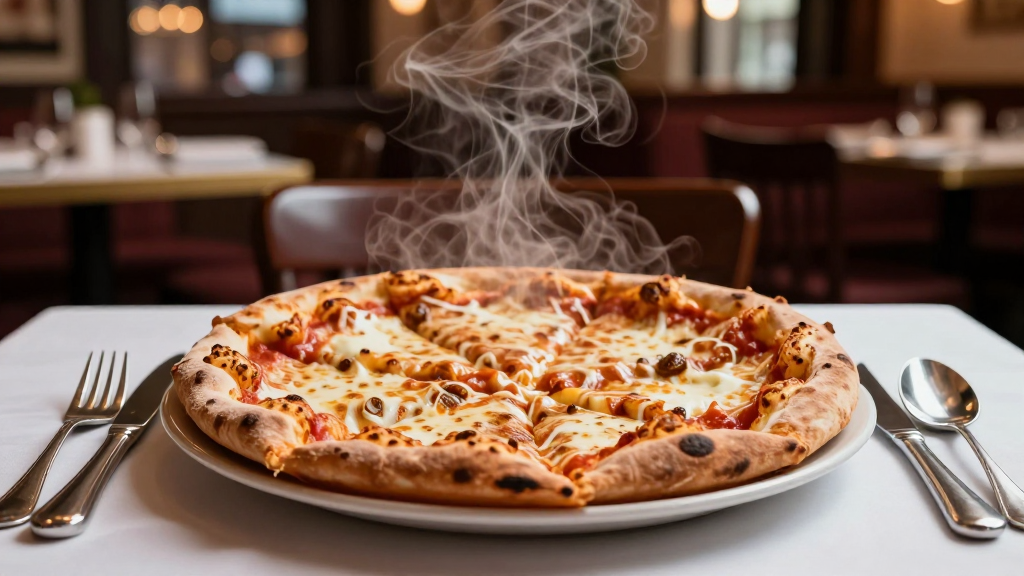
CHICAGO — Every November 1, America observes National Deep-Dish Day, the holiday on which Chicago eats a pizza that stands a full inch tall and the rest of the country asks, in one confused voice, what exactly that is.
The question, which has been asked since 1943, received new energy this morning, because the deep dish has a problem the way the moon has a problem: it is not a problem, but some people insist on bringing it up over brunch.
The problem is the spoon.
The deep dish is too saucy to hold, too structural to fold, and too dense to eat the way a New Yorker defines eating, which is while walking and mildly annoyed. It is eaten, in practice, with a fork and knife, which a significant portion of the country classifies as “cereal behavior” and a significantly larger portion of Illinois classifies as “breakfast, lunch, and dinner.”
“You don’t fold the deep dish. You arm-wrestle it,” said Marisol Vega, 16, a student at Lane Tech who consumes approximately one deep dish per week and rates the crust-to-spoon conversion rate as “four minutes, no regrets.” When asked to describe the taste for visitors, she shrugged with the confidence of the locally certain: “It tastes like the pizza you had as a kid, but somebody gave it a promotion.”
Craig Bittner, who has worked the dinner line at a South Side pizzeria for nineteen years, said the kitchen plans for the holiday the way airports plan for weather delays. His restaurant expects to serve between 600 and 900 deep dishes today. The utensil situation, he said, has rules.
“Forks for the first third. Spoons appear by the second third, and they’re not even silverware spoons — they’re whatever spoon was at the table for the salad. Nobody negotiates this. It’s physics,” Bittner said. “The crust is a bowl. We just built the bowl. You still have to drink the middle.”
That position — that the deep dish is less a food than a vessel, a bread bowl with a judicial appointment — is the official view of the city and of several aldermen, who have marked the day by issuing statements of extraordinary seriousness. One alderman’s office released a commemorative graphic that the Sun-Times would later point out depicted the pizza with a fork planted upright in it “like a flag on a mountain,” which Illinois people consider the accurate depiction and New Yorkers consider the accurate depiction of a cry for help.
Outside the Loop, opinions arrived by bus, train, and email.
“I visited Chicago for the deep dish,” said one Pennsylvanian, who requested anonymity because her husband is from Schaumburg. “It took a knife and fork and twenty-two minutes. When it was over I felt like I’d closed a deal. I have never loved a pizza that much. I have also never been so angry at one.”
Dr. Ellen Reyes-Brown, a physics instructor who has measured the problem with actual instruments, says the mozzarella layer — famously anchored against the crust to protect it from the sauce, a structural inversion that Italians describe as “the conspiracy” — sets up a tensile situation more comparable to a suspension bridge than to dinner. “When you pull a slice,” she said, “you are not cutting cheese. You are loading a cable.”
At press time, a diner at the counter of a Clark Street pizzeria was observed consuming an entire deep dish using only a spoon. The crust held. The diner declined to comment, mid-spoon. The city issued no statement, because the city had already decided this, like the crust itself, was structurally sound.