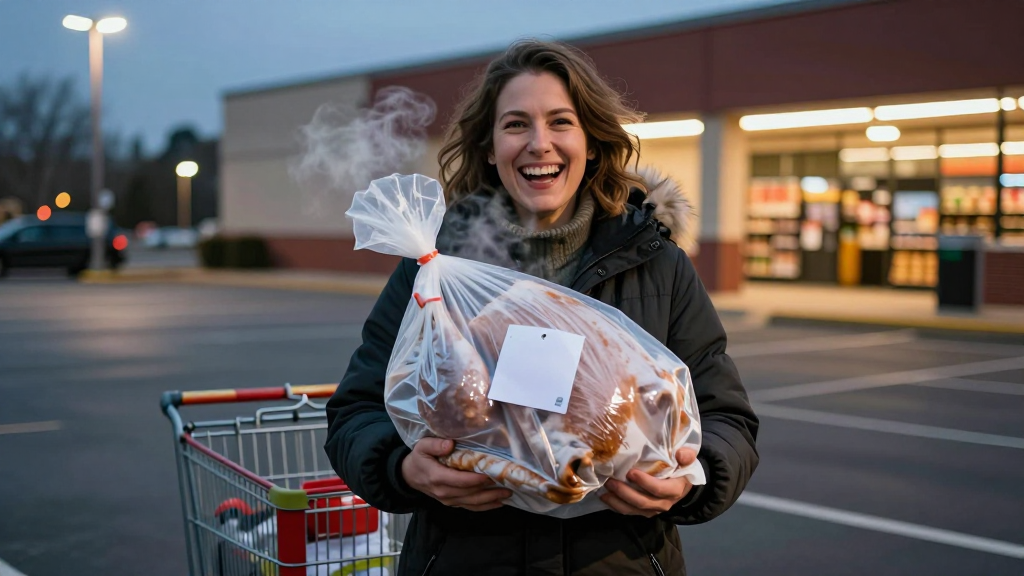
MENOTOMIE, Wis. — The line outside the Hy-Vee parking lot began at 6:40 a.m. Tuesday, ahead of the doors, which is a sentence Americans have not written about a grocery since the pandemic, and this time the cause is seventy-nine cents a pound on a frozen turkey, which the store has printed in such large type on its circular that several customers reported seeing it in their sleep.
“I came for the bird and I left with a second bird,” said Merla Pfaff, 63, a retired school secretary, explaining the two-turkey situation at her kitchen table with the calm of a woman who has made peace with it. “The first turkey was business. The second turkey was opportunity. You understand? No. Nobody understands.”
The economics, as the town repeats them, are roughly: turkeys this year are plentiful and a little dearer per pound than last year, which is the kind of news that means nothing until a corporation decides to sell a frozen bird for less per pound than a rotisserie chicken costs hot, at which point the economics become a civic event. The store limited customers to one bird. Three customers reported bringing a spouse. One customer, who gave only his first name, Dale, said he “watched a woman get turned away at the meat case with a coupon and a walker, and I have not been the same since.”
The mayor has issued a statement praising “the spirit of Thanksgiving and reasonable freezer capacity.” The high school wrestling team, which raises money selling frozen turkeys at $18 apiece, convened an emergency meeting and emerged with a plan described by its coach as “adapt or perish,” which for now means $14. The coaching staff declined to say whether this constitutes a price war; the team’s booster club president, on a radio call-in, said: “It’s not a war, it’s a Tuesday at -2 degrees, and the birds don’t care who owns them.”
Dairy nutritionists appeared on television to explain, patiently, that a turkey at 79 cents a pound is the cheapest protein in America and that the true cost is storage, which is how an expert describes the central problem of the deal: the turkeys are coming into houses faster than houses were designed to receive turkeys. The regional utility company reported a “slight but notable” increase in chest-freezer sales, three counties over, in the week the circular dropped. A Facebook Marketplace listing in Wausau offered “free freezer (minor dent, minor smells)” and was deleted within four hours, taken by someone who clearly knew what was coming.
The physics of the bird itself have produced their own minor folklore. A frozen turkey of the advertised dimensions is roughly the size of a toddler and, witnesses now unanimously report, approximately the same to carry through a store with dignity. Videos exist. The videos show strangers applauding. Merla Pfaff’s second turkey, meanwhile, has been assigned a place setting in the freezer above the peas, and Pfaff, asked what she will do with it, said the truth: she does not know, but “it’s already paid for, and it’s looking at me.”
The sale runs through the end of November, which means the turkey, in approximately one hundred million American freezers, still has a month to think about what it is.