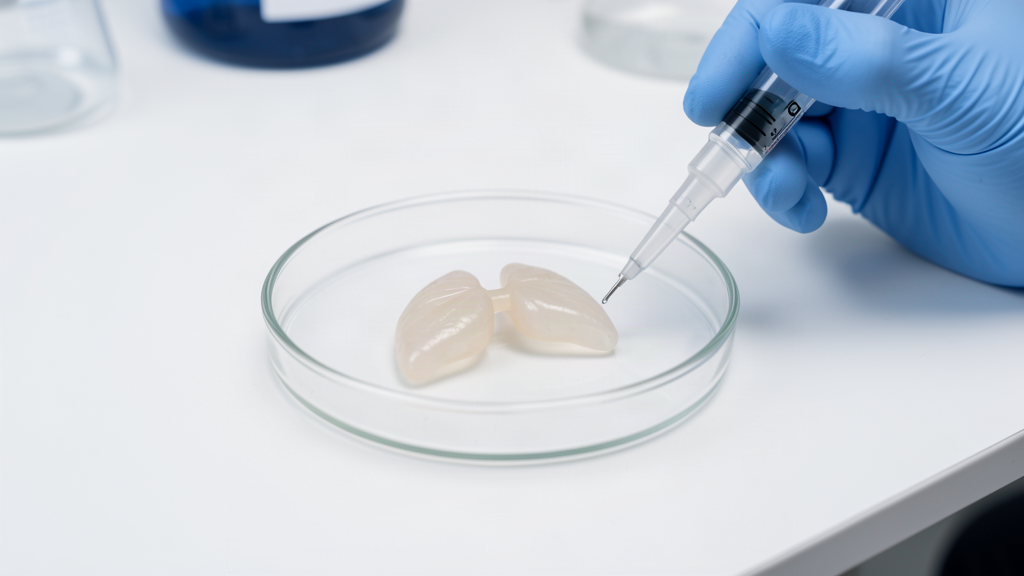
LOS ANGELES — Researchers at UCLA have developed a way to insert a fully functional gene into human airway cells using a lipid nanoparticle, restoring biological function in a laboratory model of cystic fibrosis, in what the university is calling “a proof of principle” and what one graduate student in the lab is calling “it’s alive, it’s doing the thing.”
The technique, published this week, uses a lipid nanoparticle — the same delivery vehicle that powered the mRNA vaccines — to carry a complete, healthy CFTR gene into the cells, rather than editing the existing broken one. The result, per the university, was airway tissue that, for the first time in a dish, moved mucus the way healthy airway tissue moves mucus.
“It’s not a lung,” said a senior author of the study, which is the standard phrase. “It’s a lung-shaped piece of lung.” Asked whether the distinction mattered, the author paused. “It matters in the way that a sketch of a building matters before the building.”
The significance of the work is that cystic fibrosis has, for decades, been treated by fixing the protein the broken gene makes — a strategy that has worked so well that patients who once died in their twenties now live into their forties and fifties. The new approach skips the protein and fixes the gene, in a cell, in a dish, using a delivery vehicle that is already in millions of bodies.
The team’s next step, per the paper’s final paragraph, is to scale the organoid from “a lung-shaped piece of lung” to “several lung-shaped pieces of lung,” and then, “in due course,” to a lung. A separate group, working in a different building on the same campus, is growing mini-guts. A third group, in a third building, is growing something it declined to name. The university’s regenerative medicine division, which houses all three groups, has 41 labs. The division’s intranet has a page, updated weekly, listing the 41 labs and what each is growing. The page is 41 lines long. Line 41, for the group that declined to name its project, reads: “Project (name withheld). Status: growing.”
DISH TO LUNG: WHERE THE RESEARCH STANDS
- What was grown: human airway tissue, lung-shaped, in a dish
- What was fixed: the CFTR gene, via lipid nanoparticle delivery
- What it does: moves mucus, per the paper, "as healthy tissue does"
- What it is not: a lung. "A lung-shaped piece of lung," per the senior author
- Next step: "several lung-shaped pieces of lung," then, "in due course," a lung
- Concurrent projects on campus: mini-guts (named), one unnamed project (line 41)
Cystic fibrosis researchers have described the result as “exactly what we wanted to see” and “the first time we’ve seen a gene delivered this way actually work in the tissue,” which is a phrase the university’s press office has requested be used “verbatim or not at all.”
The graduate student, who is not named in the paper and is, per the senior author, “not available for comment but available for the thing,” was seen after the press release went out holding the petri dish at chest height and looking at it. When a reporter asked whether it was, per the senior author, “a lung-shaped piece of lung,” the student said: “It’s doing the thing. That’s what matters.”
At press time, the organoid was in a humidified incubator on the second floor of a building that is, per the university’s map, the second building from the left. The unnamed project on line 41 of the intranet page was updated, at 4:07 p.m., to read: “Status: growing, and also growing.”