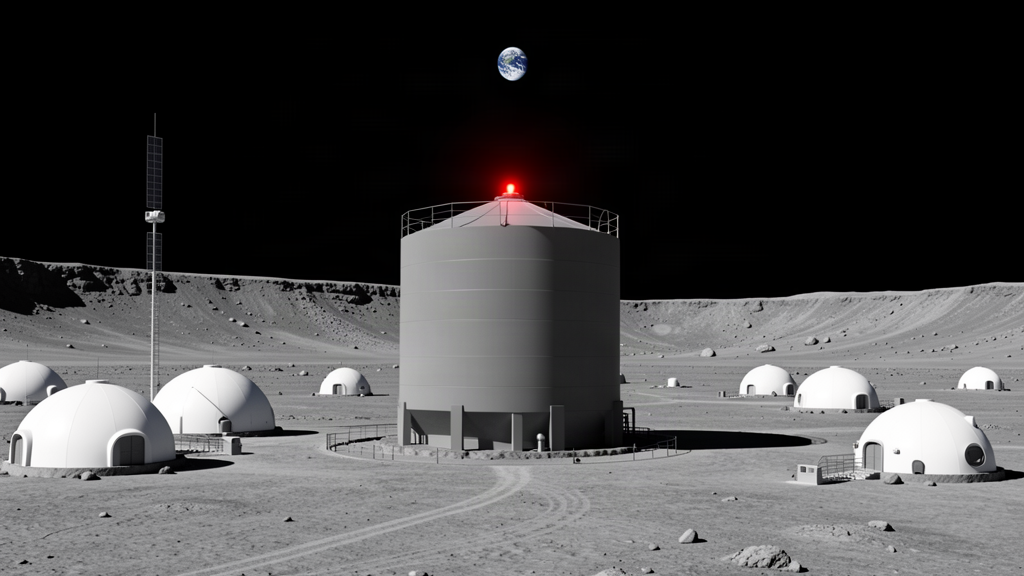
CAMBRIDGE — The moon rush is, by the account of the people who have been building rush plans, a rush. The discovery of water in the dark craters at the moon’s poles has inspired everything from small outposts to villages to cities to, in at least one public statement, heavy industry, and a pair of scientists have now done the one thing a rush cannot tolerate, which is the arithmetic.
In a new paper in Frontiers in Space Technologies, Dr. Martin Elvis and Dr. Jonathan McDowell took the most generous estimates of the available lunar water — possibly as much as a billion tons, per the orbiting missions that have mapped the polar ice since 2013 — and ran them against the most generous estimates of a lunar city, and the result, as the researchers put it in their guest editorial, is that a city of one million people would last one hundred years before the water ran out.
The math is more interesting than the headline suggests, because the good news is genuinely good. Power is not the problem. The rims of the shadowed craters sit in near-permanent sunlight — the “peaks of eternal light,” as the field calls them, slightly incorrectly — and kilometer-tall towers covered in photovoltaic arrays could generate gigawatts from those rims, enough, the researchers note, to make lunar AI data centers a plausible start of a true lunar economy. The sun, it turns out, has a one-billion-year contract with no cancellation fee.
The water is the other resource, and the water has a contract with a millennium’s worth of cold traps, and the two contracts do not match.
THE LUNAR LEDGER, PER THE PAPER
- Power: Solved, effectively. The crater rims are in permanent sunlight and the sun is, for planning purposes, a renewable source with no supply chain
- Water: Available in quantity, frozen in pits that have not seen the sun in about four billion years, and finite in a way that one million people would notice within a century
- The implication: A moon settlement is a small town with a very good power budget, not a city with a very long one
- The industry's response, so far: More of the same plans, because a rush is not a thing that reads papers
What the number does, in the end, is redraw the line between the two ambitions the rush has been carrying at once: the base, which is a survival problem with a solution, and the city, which is a plumbing problem with, per the researchers, an honest answer that is not yet a solution. The people designing the outposts are not discouraged by the arithmetic. The people designing the cities are, per one engineer who would not say whose, “revisiting the assumptions,” which is the engineering term for “the assumptions are now in the meeting.”
At press time, the polar craters were still as dark and as cold as they have been for four billion years, and the water, for its part, was still where it has always been, which is to say still not enough, on a per-head basis, for the version of the moon that has the city in it.