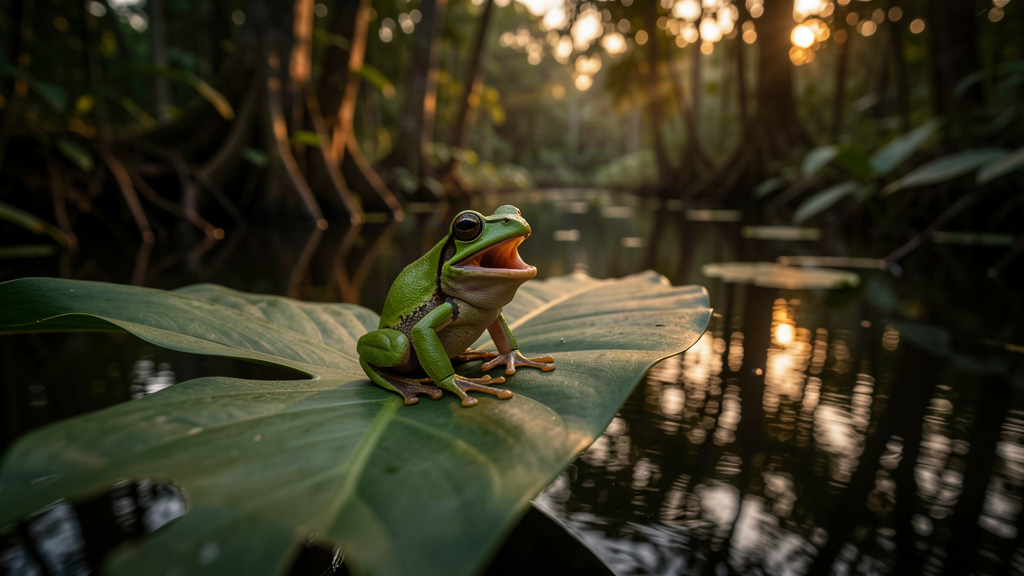
RIO BRANCO, BRAZIL — Scientists have described a new frog species in the flooded forests of the western Amazon, and the specific feature that lets it be told apart from the frogs it looks exactly like is, on the record, its call, which is, on the record, the thing a frog does that a frog’s body, on the record, does not, on the record, do.
The species, named Adenomera varcena, was identified by a team of researchers from Brazil and other countries, who distinguished it from its nearly identical relatives not by looking, but by listening, and then by running its DNA, which is, on the record, the sequence that lets a species, on the record, be a species, and not, on the record, just a frog that, on the record, is, on the record, next to another frog that, on the record, looks the same.
The specificity of the finding is, on the record, the point. The flooded forests of the western Amazon, where the season raises the waterline and the forest becomes, on the record, a lake with trees, are, on the record, a place where the light, on the record, does the work of making everything look the same, and the frogs, on the record, are, on the record, the same color, the same size, and the same, on the record, shape, and the only thing that, on the record, differs, is, on the record, the call, which is, on the record, the thing that, on the record, is, on the record, the species.
The team, per the release, used the call and the DNA to confirm it, which is, on the record, the two tests that, on the record, let a frog, on the record, stop being a question and, on the record, start being a species, and a species, on the record, is, on the record, the kind of thing that, on the record, gets a name, and a name, on the record, is, on the record, varcena, which is, on the record, the thing it is called now, and the thing it, on the record, was, on the record, not, on the record, called, on the record, before.
THE FROG, AS THE RECORD SHOWS
- The name: Adenomera varcena. A new species, on the record, with a new name, which is, on the record, the thing that, on the record, makes it new.
- The place: The flooded forests of western Acre, where the water rises and the forest, on the record, becomes a lake, and the lake, on the record, makes everything look the same.
- The look: Identical to its relatives. The body, on the record, is the same. The color, on the record, is the same. The size, on the record, is the same.
- The tell: The call. The only thing that differs, on the record, is the sound, which is, on the record, the species.
- The test: DNA, on the record, confirmed it. The call, on the record, suggested it. The two, on the record, together, are, on the record, the proof.
The reason the finding matters, on the record, is that it is, on the record, one more piece of evidence that the Amazon, on the record, is, on the record, more diverse than the record, on the record, says, and that the flooded forests, on the record, are, on the record, the place where, on the record, the species, on the record, hide, not in the leaves, on the record, but, on the record, in the difference that, on the record, is, on the record, only a sound, and the sound, on the record, is, on the record, the thing that, on the record, the record, on the record, has, on the record, been, on the record, missing.
At press time, the name was, on the record, published, the call was, on the record, recorded, and the frog was, on the record, still in the flooded forest, doing, on the record, the thing that, on the record, made it a species, which is, on the record, calling, which is, on the record, the thing it, on the record, does, on the record, whether the record, on the record, has, on the record, caught up, or not.