Sometime in the Bronze Age, a boat full of jars left shore and sank, and for roughly 4,700 years the Mediterranean kept its composure about the whole affair.
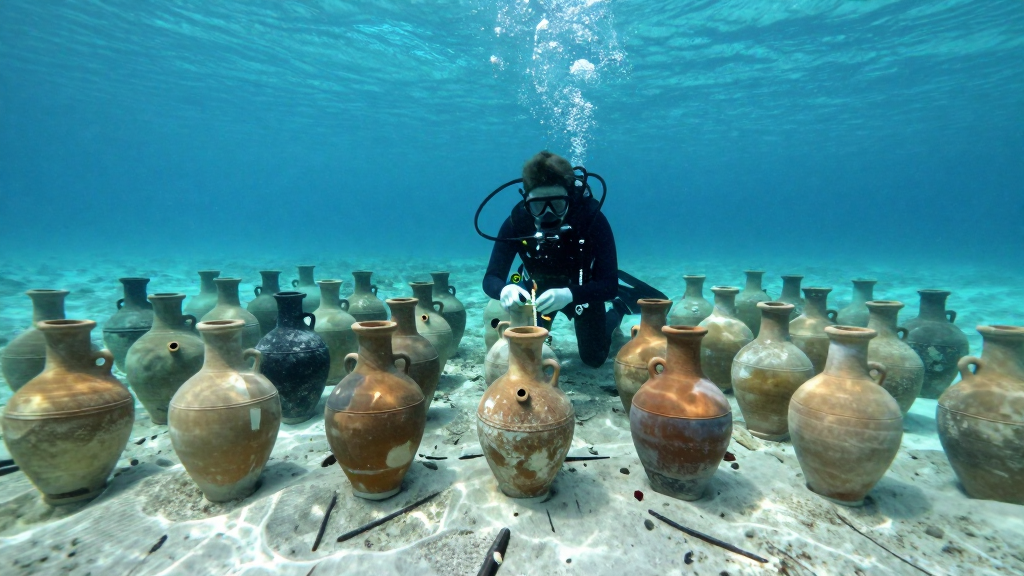
Archaeologists now report the wreck is the oldest ever found, dating to somewhere between 4,400 and 4,700 years ago — the age of the pyramids, of the first kings, of writing that had just begun taking inventory of everything, including, eventually, boats that did not come home. The site lies off Kekova Island on Turkey’s southern coast, scattered with more than thirty clay storage jars and three stone anchors, and the team that found it says the ship itself has largely rotted away.
This is the part the public keeps having to hear twice. The cargo outlived the box. The jars are fine. The hull that carried them is a dark mineral smear under the sand, while its inventory sits arranged and patient, catalogued by divers who measured each one like evidence at a crime scene where the criminal left voluntarily four millennia ago.
Hakan Öniz of Akdeniz University, who led the discovery, called the site a time capsule at the bottom of the sea, which is the standard phrase, and also, this time, accurate. A time capsule is exactly what the sea is when it takes a thing: cold, dark, salt, silence, no visitors. The Mediterranean has operated the most reliable archive in history, with a strict but fair archivist at the desk who never, ever lends anything back.
What was in the jars has not yet been announced, and the delay has a familiar texture. The ship carried goods traded four and a half thousand years ago — olive oil, wine, resin, the merchandise of a coast that was already middle-management, moving products it did not make toward customers who had opinions about them. The supply chain is older than the records that would complain about it. Somewhere in that cargo hold is the oldest shipping invoice humanity has not found yet.
Divers had hoped for gold. Divers did not get gold. The jars, which are in every way the greater discovery, arrived on site in the order they were stacked by a Bronze Age crew who understood, instinctively, what a museum would eventually become.
The excavation continues at a pace set by the sea, which is slow, and which has already demonstrated, over four and a half millennia, that it can wait for nobody and yet keep everything.
The ship is still underwater. So are the jars. For the first time since roughly 2400 B.C., somebody knows exactly where they are.