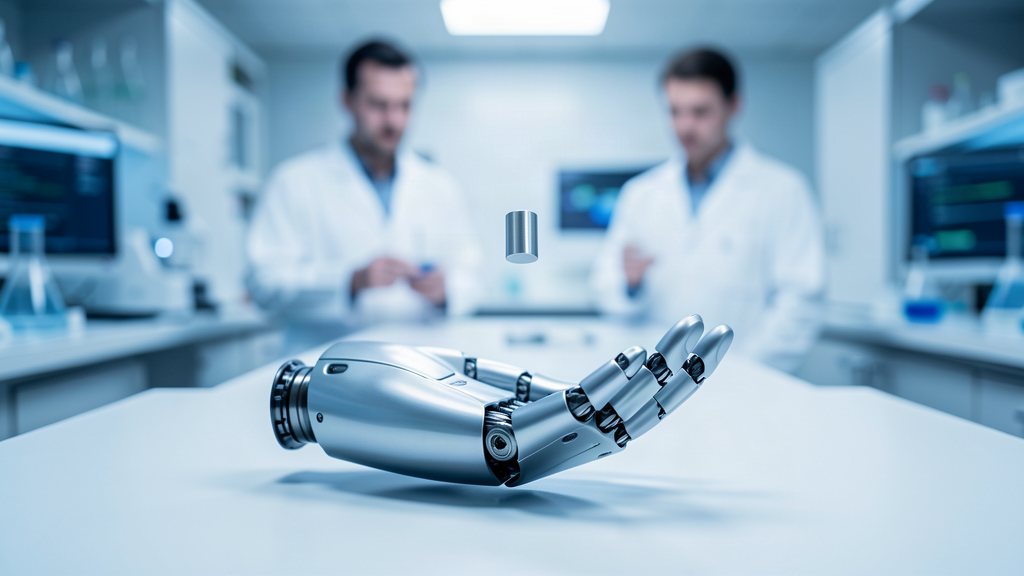
For thirty years, the bionic hand had one unfixable flaw: it never knew where it was.
It could grip. It could open. It could perform, on command, roughly the dexterity of a greeting card. But it moved without sensation, the way a garage door moves — completely, and with no opinion about it.
This week, researchers described a fix built from the oldest trick in the drawer: tiny magnets, implanted in the muscle.
The logic goes like this. When a forearm muscle flexes, it bulges, changes shape, presses. Surgeons implant a magnet no bigger than a grain of rice into the muscle. Sensors worn on the skin then read where the magnet is and how the muscle is deforming — which means the muscle itself is doing the talking, and the prosthetic is doing the listening. Flex, and the hand opens. But this time, something comes back the other way. The hand reports itself.
The participant in the demonstration — a man who lost his hand and whose nerve endings still sent the country’s most stubborn memo, that the hand was there — described the result in the sentence every prosthetics lab has been trying to earn since 1980: it feels like he is moving his own hand.
Asked to elaborate, he shrugged with the humility of a person describing a door that finally works. It closes when it closes. He knows when it closes. He had known, all these years, that the hand existed. The technology had simply taken an invitation and finally shown up.
The engineering world’s reaction was nearly unanimous admiration, which is engineering’s way of saying a competitor did it first. Other labs have built sensors into the hand itself — pressure pads, strain gauges, clever little machines asking the prosthetic how it feels and accepting whatever it says. The magnet approach stopped interviewing the hand and started interviewing the muscle, which has never once lied about anything, because muscles have no audience.
There are limits, stated freely. The magnets require a minor surgery, and the sensors are still external, still worn, still a device about a body rather than the body itself. The researchers said this plainly, in the flat style of people who intend to be quoted saying it. The word “proof-of-concept” appeared, which in science journalism means the idea is real and the calendar is not.
None of that diminished the week. For four decades the field pushed information outward — brain to motor, motor to finger, command to grip — and called it restoration when the finger moved. The magnets run the wire the other direction, from muscle back to machine and around to the person, closing a loop that has been an open circuit since the first hook was bolted to the first wrist.
The hand never knew where it was. This week, someone finally told it — with a grain of rice.