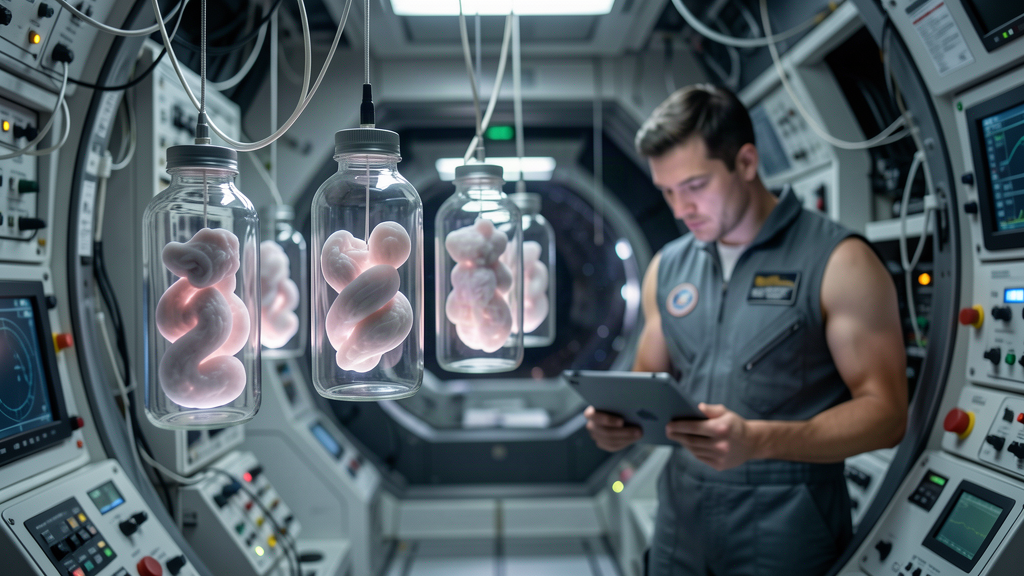
There is a man at NASA whose job title, printed exactly as it appears on his badge, is Biological Payload Custodian, and since last Thursday he has been responsible for two hundred forty tiny human brains.
The custodian, Dale Okonkwo, whose office is a windowless room in Houston with one framed photo of a frog and a desk fan that predates the station itself, acquired the brains the way NASA acquires everything: on a rocket. A SpaceX Dragon lifted off at 6:33 a.m. Eastern on October 13 from Cape Canaveral on the company’s 35th commercial resupply flight, docked with the station two days later, and unloaded the strangest cargo manifest of the year: lab-grown brain organoids, three-dimensional heart tissue, equipment for manufacturing artificial retinas in orbit, and, for balance, a set of solar arrays.
“The brains arrived, and I want to report for the record that they were exemplary,” Okonkwo said, in the flat professional tone of a man reporting on a hotel inspection. “No noise complaints. No weight issues. They don’t eat. The heart tissue beats a little at night, which the crew finds comforting, and the retinas haven’t done anything at all yet, which is also fine.”
This is the argument for tiny brains, delivered by the man closest to them: as tenants, they are unbeatable. A brain organoid is a cluster of human nerve cells grown in a bioreactor until it reaches roughly the size of a lentil and begins, occasionally, to show electrical activity. It cannot speak, sue, complain about the exercise machine, or request a personal quarters. It weighs, in round numbers, less than a grape. And it launches for the same price per ounce as everything else on the manifest — a figure the agency will not print on a public website but which Okonkwo will happily state, because the agency knows he will: about $100,000.
“What people misunderstand about the brain business is the humility,” Okonkwo said. “We are not sending up a mind. We’re sending up the mind’s ingredients, in the packet, to see what happens when you take out gravity. Everything in that package — the brains, the heart stuff, the retina printer — is about one thing: tissue in space behaves like tissue on Earth only if you lie to it well enough. We’re learning to stop lying.”
The experiments run about five weeks. Organoids grown in microgravity develop blood-vessel-like structures and organize differently than their flat, dish-bound cousins, which matters to researchers hoping the differences will illuminate stroke, aging, and the parts of Alzheimer’s that appear first at the cellular level rather than the last. The retina-manufacturing rig is there for a simpler reason: protein crystals and delicate cell layers grown in orbit come out whole, uncrushed by their own weight, the way a soufflé would come out if no one had ever invented an oven rack.
Okonkwo has been custodian of biological payloads for eleven years, which means he has personally been responsible for beetles, spiders, squid embryos, tomatoes, and now the quiet lentils of his current command. His wife, he said, asked whether the brains were “people now.” His answer, delivered without notes, was the correct one in both directions: “They’re two hundred forty very good guests, and when the next Dragon comes home, they’re getting on it, and I’ll be checking the manifest the same way I check everything.”
The study results come back on the next cargo return, whenever the brains are ready, which scientists say will be sometime in November, at which point Okonkwo’s office will go back to the fan, the frog, and the next manifest.