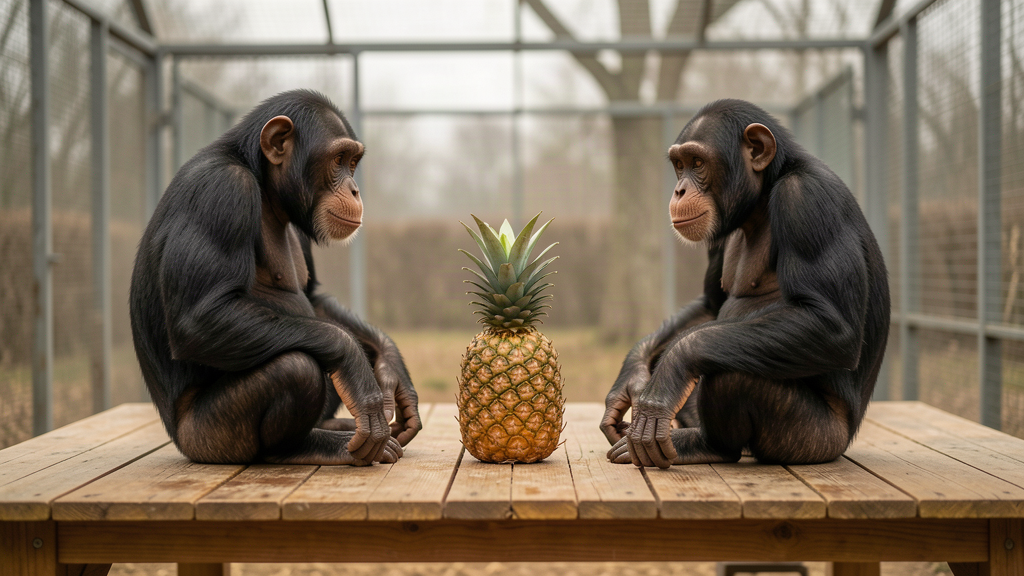
A controlled experiment has produced the cleanest result of the year, and it cost almost nothing to run: two chimpanzees, one pineapple, and a rule nobody wrote down.
The finding, from a team that included researchers at Berkeley, is that chimpanzees steal less food from their friends than from strangers. The food was pineapple. The theft was measured. The friendship was not a feeling but a history — the animals had been observed grooming, resting, and tolerating one another long enough to be classified as bonded, which is the scientific term for “these two have been through something together.”
The restraint was not the only discovery. The expectation was. The chimps appeared to assume their friends would also hold back, and when a stranger took the fruit, the thief lingered in visible bad humor far longer than a thief who had stolen from a friend. In other words, the strangers’ thefts were treated as hostile acts, while the friends’ thefts were treated as a misunderstanding.
This is the part that will be quoted in every office in America by Thursday. A friend takes your lunch from the refrigerator and you assume it was a mistake. A stranger takes your lunch and you begin a campaign. The chimpanzee does exactly this, with pineapple, and has apparently been doing it for six million years without once posting about it.
The researchers were careful about the meaning. They did not say chimpanzees have friendship the way humans do. They said friendship, in whatever form it takes, changes the rules of a conflict, and that the change is measurable in a single fruit. That is the whole paper, and it is a remarkable thing to be able to say out loud: the rules are different for people you like, and the difference is old, and it is not a policy. It is a reflex.
The experiment’s design deserves the credit. A pineapple is the perfect instrument, because a pineapple is too large to share politely and too good to leave. It forces the question the study was built to ask: how much do you want this, and how much do you like the other guy, and which one wins when both answers are yes?
The friends, more often than not, let the pineapple go. The strangers did not. The chimpanzees were not graded on morality. They were graded on restraint, and restraint, it turns out, is not a universal law. It is a favor, and favors are extended to the people who have already extended them.
The study is published in a peer-reviewed journal. The pineapple was, by all accounts, fine.