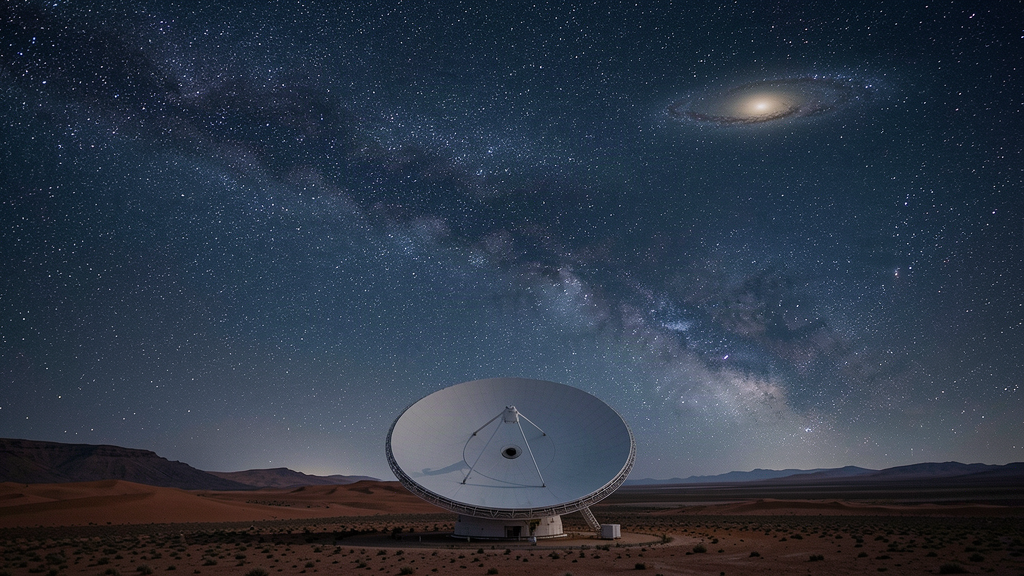
LAS CRUCES, N.M. — Astronomers have discovered a brand-new satellite galaxy of the Milky Way, located some 350,000 light-years away, and the discovery, by every account, was made in test images taken before the telescope that made it was officially turned on.
The galaxy, named Aquarius IV for the constellation in which it sits and the Roman numeral that, in the specific, is the fourth one, was identified by a team analyzing commissioning data from the Vera C. Rubin Observatory, the great eye on the desert that has, in the specific, found something in its very first test pictures the way a new oven finds toast in its preheat. The object is one of the faintest and most compact dwarf galaxies ever seen at such a distance, a fact the team described, in the paper’s own language, as noteworthy.
"The telescope was in calibration mode, which is the telescope's way of saying it is not ready, and then it found a galaxy, which is the universe's way of saying it was ready for the telescope."
That line is from Dr. Anita Voss, a galactic-structure researcher who was not involved in the discovery and who described the sequence of events as “the most encouraging calibration result I have seen in twenty years, which is to say the only encouraging calibration result I have seen in twenty years.” In commissioning, the explanation runs, a telescope is pointed at the sky while engineers verify that the mirrors, the cameras, and the software are doing their jobs. The sky, Dr. Voss noted, is not in the software. The sky has, in the specific, been doing its own job, and has always had more patience than the software.
The galaxy itself is, by the measurements, a small thing. It sits in the outer halo of the Milky Way, the great diffuse skirt that astronomers describe as the part of the galaxy you cannot see and that, in the specific, is doing most of the work. Aquarius IV contains a fraction of the stars of its host, an amount the team compared, in the paper’s analogy, to a single grain of sand in a stadium full of sand, which is an analogy astronomers use because the actual number is smaller than the grain.
The discovery was confirmed independently using archival images from a second camera in Chile, a process that in astronomy is called, in the technical literature, “not making a mistake,” and that in the trade is the difference between a discovery and a press conference.
AQUARIUS IV: SPECIFICATIONS
- Distance: Roughly 350,000 light-years from the center of the Milky Way, which is, on the record, inside the halo, and the halo is, in the specific, the outside.
- Size: One of the smallest and faintest known at that range. The team's description: "a smudge." The smudge is the object. The object is the discovery.
- Star count: A rounding error, in the team's words, relative to the hundreds of billions in the main disk. The rounding error is, in the specific, 350,000 light-years of its own weather.
- Date of discovery: Before the telescope's mission began. The telescope's mission, per the schedule, is to take the pictures. The galaxy, per the picture, was already there.
For the Rubin Observatory, the find is a credential. The survey is designed, in its own description, to find exactly this kind of object, and to find it before it is officially on the job is the way a survey proves its specifications, which is to say it is the way a very large machine and a very patient sky shake hands before the handshake is, in the specific, legal.
At press time, the observatory was still in its early science phase, its full survey was still weeks from beginning, and the galaxy it found in its test pictures was, per the team, still doing what the galaxy does, which is sitting 350,000 light-years out, waiting for the telescope to finish getting ready for it.