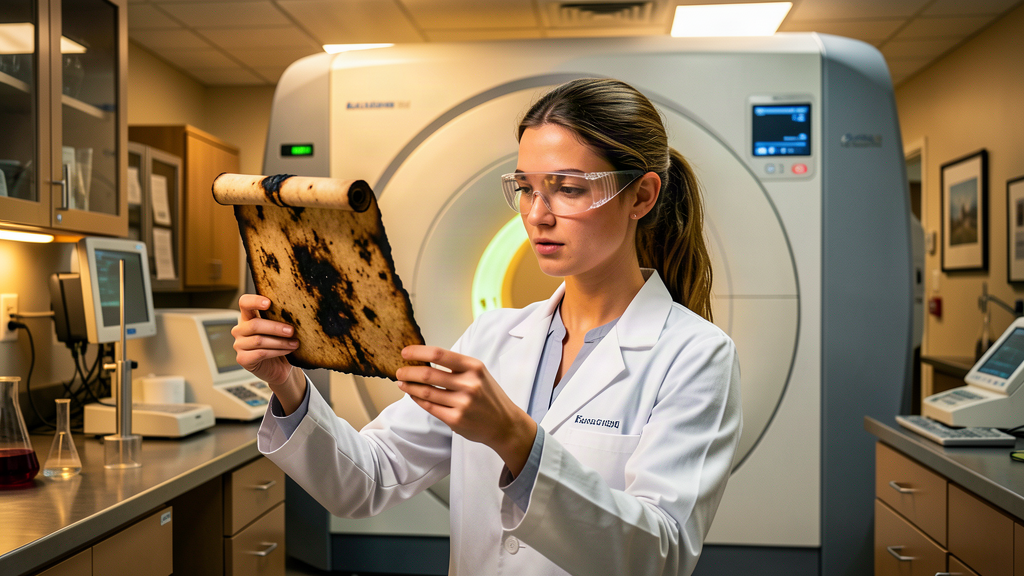
BERKELEY, California — The most reliable way to learn how to read a 2,000- year-old carbonized scroll, a team of researchers at the University of California, Berkeley, has determined, is to make a fresh one. The team wrote on papyrus, charring it the same way Mount Vesuvius did to the collection at Herculaneum in 79 A.D., then ran the results through an X-ray scanner — finding that even a trace of lead in the ancient ink makes the letters stand out dramatically against the scorched material, a result they published this month in the journal PLOS ONE.
The method is, on its face, an act of archaeological violence: to solve a mystery about destruction, you commit a small, controlled amount of the same destruction. The researchers, speaking through a press release that used the word “char” in the past tense seven times, described the process as “the only way to be certain,” which is, in the laboratory vocabulary, a strong statement from people who have other options.
The broader project — the Vesuvius Challenge — has been racing against time for decades. The Herculaneum papyri, more than 1,800 scrolls carbonized when the villa was buried by pyroclastic flow, have resisted every physical unwrapping attempt since the 1750s, at which point the scrolls began, as one conservator described it, “to do what they always do,” which is to fall apart. The X-ray method, in which a machine reads the scroll without touching it, has made progress. But progress, in this field, is a word that is used loosely.
A separate international team announced this month the complete virtual unwrapping and first full reading of a carbonized Herculaneum scroll — a text spanning roughly 1.4 meters of papyrus across 22 columns of ancient Greek — using AI algorithms to separate the ink from the papyrus, a task that was, until about three weeks ago, considered impossible because both were made of, in the researchers’ words, “mostly the same thing.”
THE METHOD, PER THE METHOD
- Write on papyrus
- Char it the way a volcano would have
- Scan the result with X-ray CT
- Compare the lead-ink signal to the carbon signal
- Conclude that lead is the variable
- Apply to scrolls that have been on fire since 79 A.D.
- Publish, noting the method "works"
The practical upshot is that the scrolls which were previously unreadable may now be, in time, readable. The scrolls which are readable now will continue to be readable. The scrolls which are neither — the majority of the collection, by some counts — will remain, in the researchers’ words, “a challenge for future generations,” a phrase that in archaeological literature means “we are not promising anything, but we are also not done.”
At press time, the Berkeley team had charred approximately forty model scrolls. A conservationist, asked whether the team had considered asking the scrolls politely, said the team had, and that the scrolls had not responded. The lead content of the original ink, according to the same source, was a byproduct of the writing materials the ancient scribes used, which means the scrolls, in a sense, came pre-equipped for the only reading method that works. The researchers described this as “convenient.” A volcanologist, asked for a reaction, said “also convenient” and declined to elaborate.