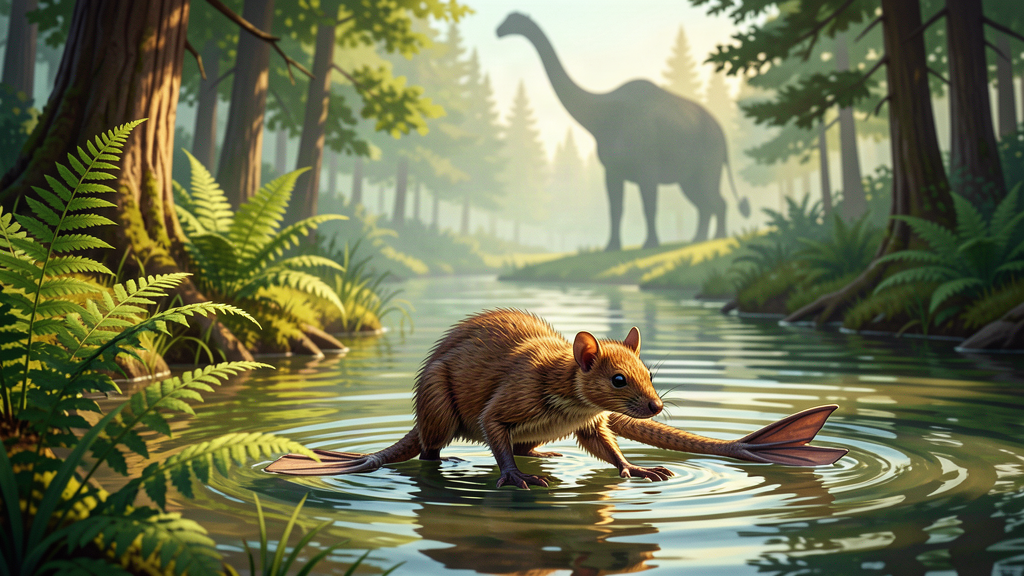
CAMBRIDGE, MASSACHUSETTS — Paleontologists have described a new dinosaur-era mammal that swam like a platypus, paddled with webbed hands and feet, steered with a flattened tail, and, in the detail that has delighted every parent who has ever watched a child lose a tooth, replaced its teeth multiple times.
The animal, described in detail by Sci.News, shows adaptations for semiaquatic life “with hands and feet like the platypus that were similarly webbed,” and a tail built like a nutria’s for pushing through water. It lived while dinosaurs ruled, which is the part that makes the discovery so inspiring: this mammal was out here perfecting swimming, paddling, and dental logistics while the big animals were still figuring out their necks.
Science writers are calling the teeth the headline feature, and they are right to. A mammal that never runs out of teeth is a mammal that never has to slow down. It simply keeps going, the way a good employee does, and the fossil record has now caught it in the act.
“We have spent a century saying mammals from this era were tiny, nervous, and land-bound,” said the study’s paleontologist, visibly moved. “Turns out one of them had a boat body and unlimited teeth. We were the ones who were nervous.”
THE ANIMAL'S RESUME
- Webbed hands and feet, independently invented, mirroring the platypus like a polite student copying the best desk in class.
- Flattened tail bones, arranged dorsoventrally, which is how you know the tail was doing real work.
- Multiple tooth replacements, a system so practical that dentistry has still not caught up to it.
- Cretaceous employment, held continuously alongside animals ten thousand times its size, with no reported incidents.
The convergence with the platypus is the part to sit with. Two mammals, separated by oceans of time, both looked at a river and both decided: webbed feet, paddle tail, keep swimming. That is not coincidence. That is the universe submitting the same excellent idea twice, which is what excellent ideas do.
At press time, the research team announced it is searching river sediments for a second specimen, on the theory that an animal with unlimited teeth probably also had opinions about the Cretaceous, and the sediments owe us the transcript.