PASADENA, CALIF. — NASA’s Curiosity rover has spent 5,000 Martian days on another planet, and to mark the occasion it sent home a postcard, which is the kind of thing you do for a birthday, and the kind of thing a machine does when its handlers love it.
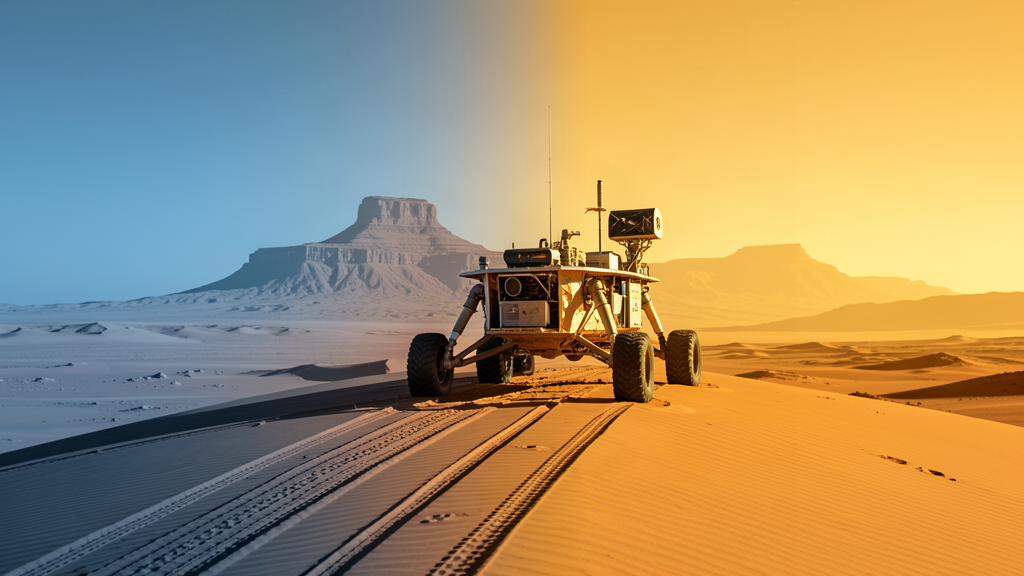
The postcard was made by photographing the same sand ridge — nicknamed Chocolatal, at the base of Mount Sharp — twice, once on the morning of sol 5,000 and once on the afternoon of sol 5,003, then merging the two black-and-white panoramas and adding color by hand: blue for the morning, yellow for the afternoon. The blue is not water. The color is an artistic interpretation, and NASA said as much, which is the honesty of an institution that could have just called it a picture and didn’t.
The point of the two-pass trick is not decoration. It is to show how much the light on Mars shifts between breakfast and dusk, a shift so subtle that you need fourteen years of patience and a hand-colored composite to see it. Fourteen years. Curiosity landed in 2012, and it is still working, still photographing, still mailing us postcards from a ridge named after chocolate, on a planet where nothing else is alive to notice.
5,000 SOLS, AT A GLANCE
- Milestone: sol 5,000, captured at 9:56 a.m. local Mars time on August 30.
- Location: a sand ridge nicknamed Chocolatal, at the base of Mount Sharp.
- Method: two black-and-white panoramas, merged, colored by hand.
- Blue: morning. Yellow: afternoon. Grey: the actual surface, present in both.
- Precedent: NASA has built these composites before, including one in November 2021, as has been well-documented.
At press time, the rover had been parked at the ridge for several sols, which for Curiosity is not idleness but a milestone: the machine stopped working long enough to look at itself, and the people on Earth looked back, and both agreed the view was nice.