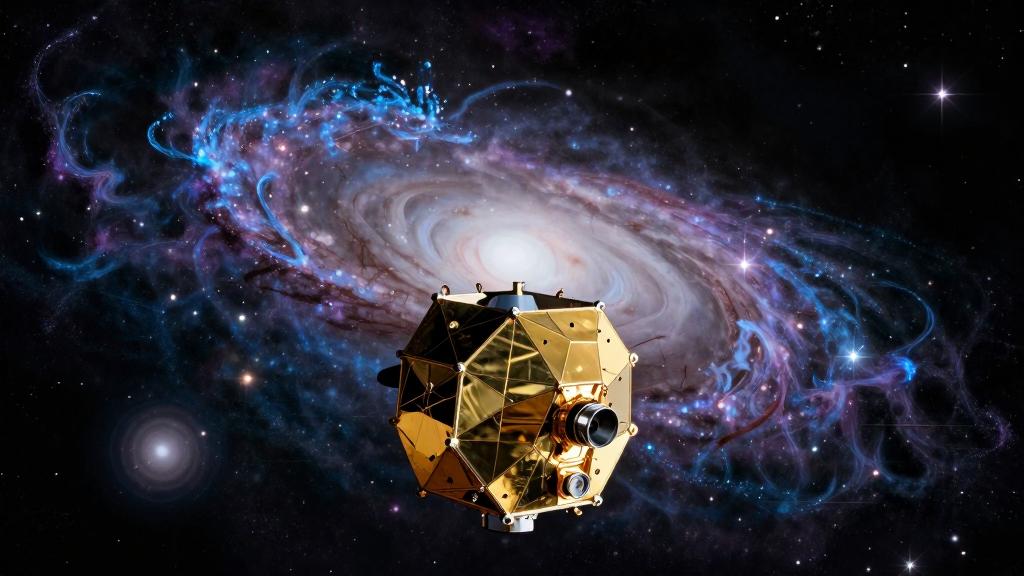
The universe has been running the same show for six and a half billion years. On Monday, humanity admitted it had been watching without binoculars.
1. THE GALAXY WAS ALWAYS LIKE THIS
There is a galaxy, 6.5 billion light-years away, that astronomers have taken to calling the Dragon. It sits behind an enormous foreground cluster of galaxies, and clusters of galaxies are heavy — so heavy that they bend the light of everything behind them, a trick of general relativity called gravitational lensing, which is what happens when the universe agrees to help. Gravity did not have to help. Gravity is famously not helpful.
2. THE RECORD WAS 44. NOW IT IS 104.
Using the James Webb Space Telescope, a team identified 104 magnified stellar events in the Dragon — stars doing something brief and bright, caught in the act, stretched and enlarged by the cluster’s gravity like a print held up to a magnifying glass. The previous record for such events in a single lensed galaxy was 44. The team did not double the record through better engineering alone, but largely by looking at a galaxy that had a lot of stars, which the team credits as a key part of the method.
3. THE HIDDEN PART IS THE POINT
The Dragon matters because of what holds the lens together. Most of the cluster doing the magnifying is dark matter, the invisible scaffolding of the cosmos, and the sharper the lens sharpens, the more the astronomers can map the scaffolding by studying the way the light wobbles. The team describes the result as a new way to investigate dark matter. The public describes it as getting information about the thing you cannot see by watching the thing you can see get distorted, which is also how you find out what is inside a water glass.
The Dragon, by the Numbers
- 104 magnified stellar events, identified and confirmed
- 44 — the previous record, an embarrassing 44
- 6.5 billion light-years, each way, roughly
- 1 telescope; the magnification came free with the gravity
- 0 galaxies consulted during the research
“We keep pointing it, and things keep being there,” said a postdoc on the team, who offered this as the least surprising and most thrilling sentence in science. The team expects the record to break again, possibly within the year, possibly by the same team, a possibility they describe as likely and then immediately explain as a matter of scheduling.
The galaxy, meanwhile, has a six-and-a-half-billion-year backlog of things that already happened, and the telescope has only just started returning the calls.