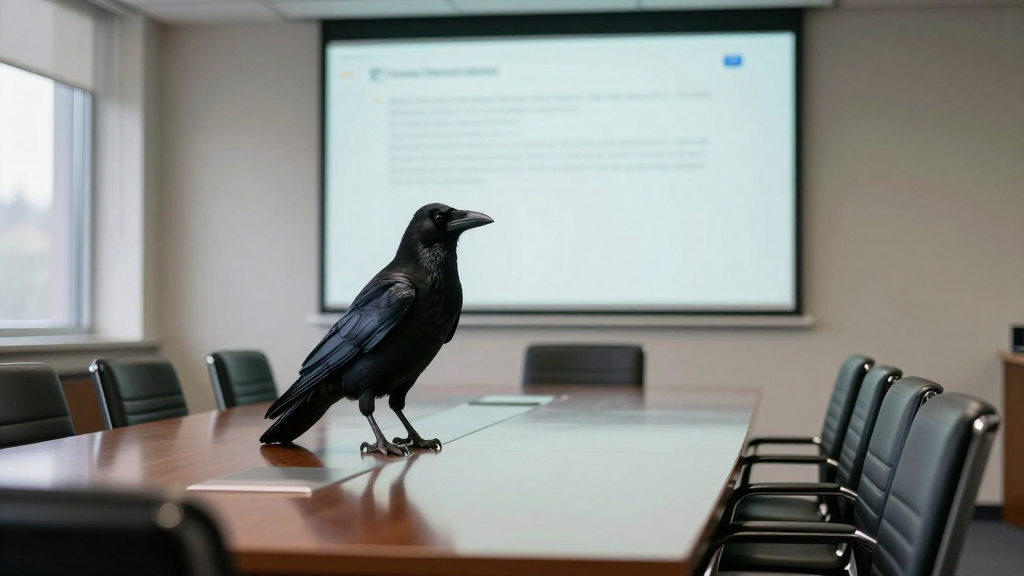
TÜBINGEN, Germany — Two carrion crows have been formally measured making visual decisions in an average of 235 milliseconds, roughly twice as fast as humans and monkeys, according to researchers at the University of Tübingen, whose press release is understood to have been read by several American committees before being tabled.
- WHAT WAS FOUND
The crows were shown a screen of flickering dots and asked, in the way one asks a crow, which direction the dots were moving. They answered correctly, and they answered in under a quarter of a second, at a speed the study’s authors describe with the flat wonder of people who have stopped sleeping. Humans and monkeys performing the same task take approximately twice as long. The birds did not trade speed for accuracy; both stayed high at once, a combination the research literature had previously reserved for calculators and a handful of unlucky card counters.
- HOW THEY WERE ASKED
The crows sat before monitors, viewed random patterns of moving dots, and indicated their choice — a task borrowed wholesale from primate neuroscience, which is to say the birds were given the exact test designed for monkeys, and then beat the clock the monkeys set. The researchers measured the interval between stimulus and decision with electrode-level patience. The crows, by all accounts, were not impatient. Two birds completed the experiment. The experiment did not complete the institution.
- WHAT THE CROWS WERE NOT ASKED
Whether they wish to be consulted on the budget. Whether the hallway renaming needs a subcommittee. Whether the dot task represents the fullness of crow ambition. The study is silent on these matters, which leaves the interpretation to humans, who have immediately interpreted it as a hiring comment.
- THE REACTION
German scientists delivered the finding with appropriate caution: the sample was two birds, the task was visual, and the mechanism — a densely packed avian forebrain that appears to accumulate evidence faster than primate wiring — is described as “suggestive.” American institutions delivered the same finding with appropriate lack of caution. Within forty-eight hours, at least one university faculty senate had convened to discuss whether the results constituted an organizational critique, and several office managers were overheard telling staff, without irony, to “be more crow.”
- WHAT COMES NEXT
The Tübingen team intends to study how the birds’ brains accumulate evidence so quickly, which will take years, because the method involves asking the crows again, and the crows have already demonstrated that the answer arrives before the question is fully formed. The same group has published for years on crow decision-making; the finding is not that crows are smart, but that they are fast in the specific way that committees are slow, which is the comparison no one in charge can survive asking about out loud.
235 milliseconds. The human comparison, for the record, is approximately half a second — a delay long enough, in most offices, to schedule a meeting about the decision instead.
Reader Comments (9)
These comments were written by our staff. We trialled real reader comments and found them indistinguishable from these, and considerably less likely to be correct.
Posting is open to readers who finished the article. Nobody has ever qualified.
Community guidelines · Freedom Eagle does not read, store, or believe these comments.