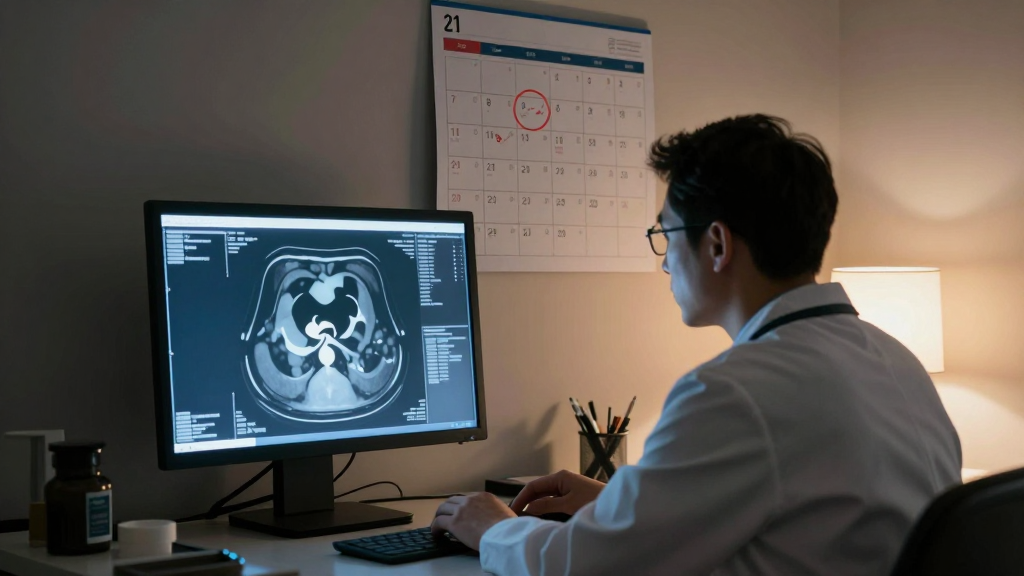
The scan, in every sense a radiologist could check, was normal. The patient felt fine. Four hundred and seventy-five days later, the diagnosis came anyway — and in hindsight, Mayo Clinic researchers now report, the answer had been quietly glowing in the file the entire time.
Their system is called REDMOD, and it does not wait for a diagnosis. Trained on CT scans taken for unrelated reasons, it flags the hidden prediagnostic signatures of pancreatic cancer an average of 475 days before clinicians caught the disease, at nearly twice the sensitivity of experienced radiologists reading the same images, according to the study published in the journal Gut. Pancreatic cancer, for those keeping score at home, is the kind of cancer that keeps its own score, silently, for months.
The machine’s lead-time advantage is precisely the number in the headline: the median signal appeared more than fifteen months ahead of diagnosis. Fifteen months. One winter, one spring, the better part of a second one.
We reached Dr. Renata Alvarez-Moore, a radiologist who was not part of the study but who reads abdominal imaging for a living, to ask how her profession is processing the news that a computer has beaten it at its central trick.
“Twice the sensitivity,” she said. “Let me say that again slowly, so my department hears it: twice.” A pause. “The scans we called normal were not normal. They were normal to us. There is a difference, and the difference just got an upgrade.”
Her colleagues, she said, are not angry, exactly. The mood is closer to the feeling of losing a long card game to your own niece.
“The honest part is that we have been working blind in that organ for thirty years. Pancreas sits behind everything, the way a stubborn relative sits behind the whole Thanksgiving table. If a tool can see through the table — why would we not want it in the room?”
The study has limits, and the researchers deserve credit for saying so first: it was retrospective, which is medicine for “the answers were already in the files,” and REDMOD must now prove itself on patients who do not yet have chart endings. Trials are coming. That is the part where everyone in science says “not yet” in a serious voice.
What the numbers already do, however, is move the dread. A country that waits for symptoms has been, in a sense, waiting politely. A country with a tool that flags trouble fifteen months early waits differently — with a calendar, a follow-up appointment, and a brand of anxiety that is technically called “survival odds” and colloquially called “getting your life together in advance.”
Dr. Alvarez-Moore has kept her reading room exactly as it was. The monitors, the lamps, the coffee that tastes like the third hour of a shift. On her desk she keeps the study printed out, and she turns to it when a pancreas scan looks, in every sense a radiologist could check, normal.
The machine, on the other hand, has a reading room that never sleeps, never drinks the coffee, and has already read this year’s files. When asked what she thinks of that, Dr. Alvarez-Moore said the word “colleague” — then laughed — then said it again, slower, the way a person does when they notice they have chosen the right word.