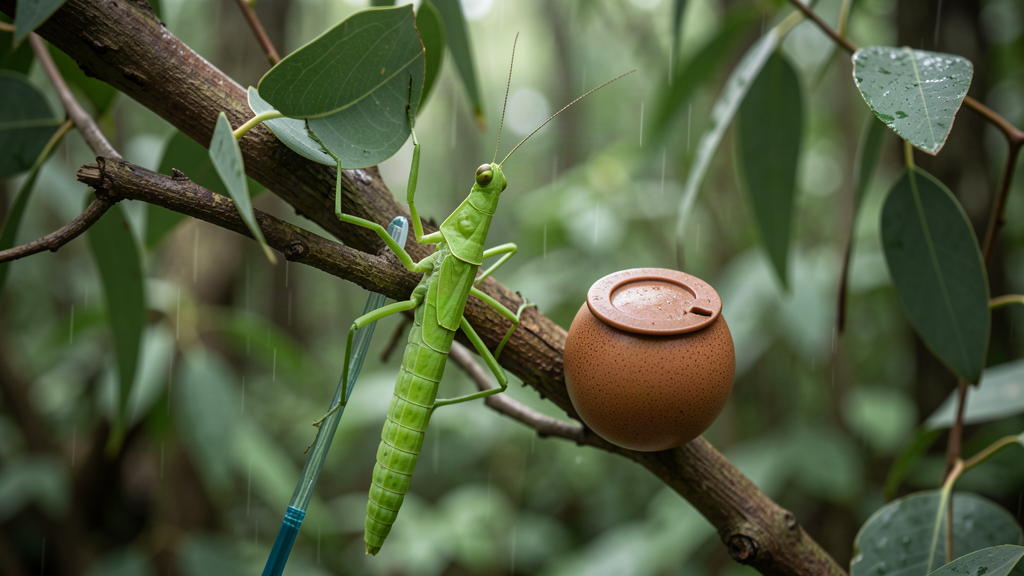
SYDNEY — A University of Sydney research team reexamined the Australian members of the stick insect genus Anchiale and discovered two new species, one of which lays eggs with a lid. The lid has concentric rings. It has never been recorded in any stick insect or its closest relatives. And the researchers have, in the polite language of a journal article, admitted that the egg is more interesting than the insect, which is the correct order of things.
The new species, Anchiale mabiensis, lives in the Mabi rainforest in northern Queensland and grows to about 16 centimeters, roughly the length of an adult’s toothbrush. A toothbrush is the honest scale here. The insect is large for a stick insect and small for an animal, and the discovery is being reported with the appropriate amount of excitement for a bug the size of a toothbrush that has a lid on its eggs. The lid is the headline. The insect is the delivery mechanism for the lid.
The second finding is the one that stings. A third species, Anchiale robusta, had been misidentified for decades — hiding in plain sight, as the Smithsonian put it. Scientists had looked at this insect, named it, published it, and taught it, and were wrong about it for fifty years. The correction came from reexamining eggs. The team did not find the insect; the team found that the insect had always been there and the eggs disagreed with the label. The eggs were right and the scientists were wrong, and the scientists wrote it down, which is the most admirable thing a scientist can do.
THE ANCHIALE AUDIT: WHAT THE EGGS SAID
- New species one: Anchiale mabiensis, Mabi rainforest, toothbrush-length, lidded egg.
- New species two: Atherton Tablelands, described from egg structure.
- Old species: Anchiale robusta, misidentified for 50 years.
- Evidence that fixed it: Concentric rings on a lid, never recorded before.
- Method: Reexamining what everyone had already examined.
The conservationists say the discoveries draw attention to the need to protect the insects’ habitats, which is true, and also the quiet admission that you cannot protect a species you have mislabeled for half a century. The Mabi rainforest is endangered, the insect is endangered, and the egg has a lid that science has only now noticed. At press time, the largest stick insect in the world, Ctenomorpha gargantua, 60 centimeters long, remained unimpressed by all of this. It does not have a lid.