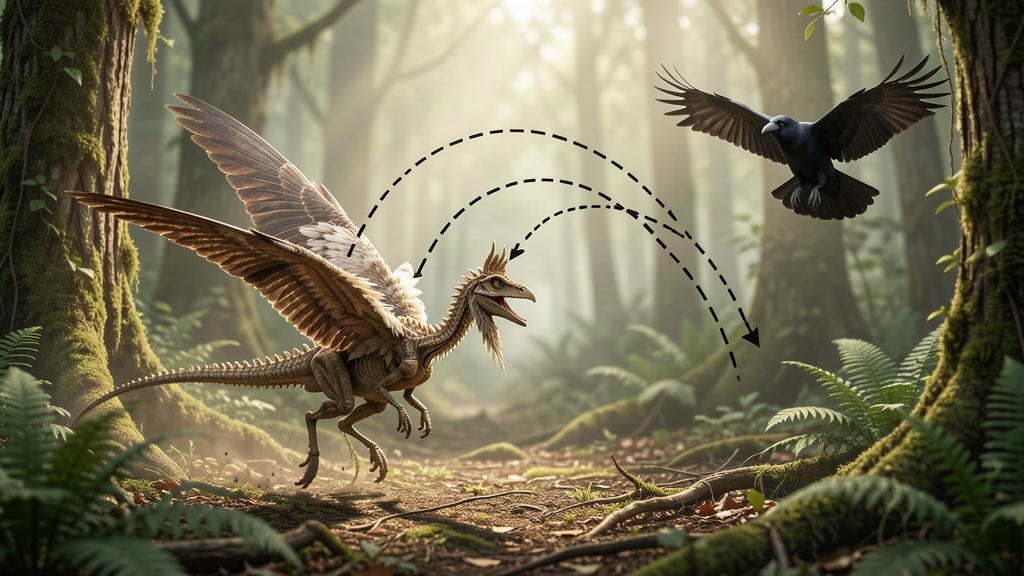
LONDON, ENGLAND — For 150 million years, the origin of flight has been getting better press than the origin of, say, the semicolon. Now a new biomechanical study has settled the oldest question in ornithology: the first bird didn’t leap into the sky like a superhero. It hopped. Twice or three times. Like a crow. Like a very small, feathered, 150-million-year-old crow.
The study, published in Developmental Biology, used computer simulations of a 400-gram Archaeopteryx to show that the earliest bird could have reached a sustainable flight speed of seven meters per second with as few as two or three bipedal leaps — or two leaps with a downward flap in between — rather than the single explosive jump modern birds use. Sci.news reports on the findings, and SciTechDaily frames it as the solution to a 150-million-year-old mystery, which is how the trade describes any paper that has been sitting in the ground since the Jurassic.
Lead researcher Pauline Provini of the Muséum National d’Histoire Naturelle in Paris said the single-leap model was “energetically demanding” for a bird of Archaeopteryx’s size, which is the scientific way of saying that the first bird’s flight plan was not a plan so much as a series of increasingly committed jumps. Her former doctoral student Erik Meilak, who carried out much of the modeling at the University of Southampton, put it more plainly: three hops, and you’re airborne. “It’s basically what crows do,” he said, which is the finding every crow in Europe has suspected for a hundred million years without getting a journal for it.
The practical implication, according to the study, is that flight evolved in a way that was “accessible” to small animals, which is the scientific way of saying that the bar was, for a time, set at “a series of hops.”
FLIGHT 101: THE EARLY EDITION
- Subject: Archaeopteryx, 400 grams, 150 million years old
- Old model: one dramatic leap (heroic, expensive)
- New model: two to three hops (practical, a little undignified)
- Cruising speed achieved: seven meters per second
- Modern equivalent: a crow, doing crows things
- Publication: Developmental Biology, the journal where discoveries of this magnitude land
At press time, the team said the model “opens new avenues for research,” which, in paleontology, means someone is already making a very small dinosaur hop into a very large grant application.