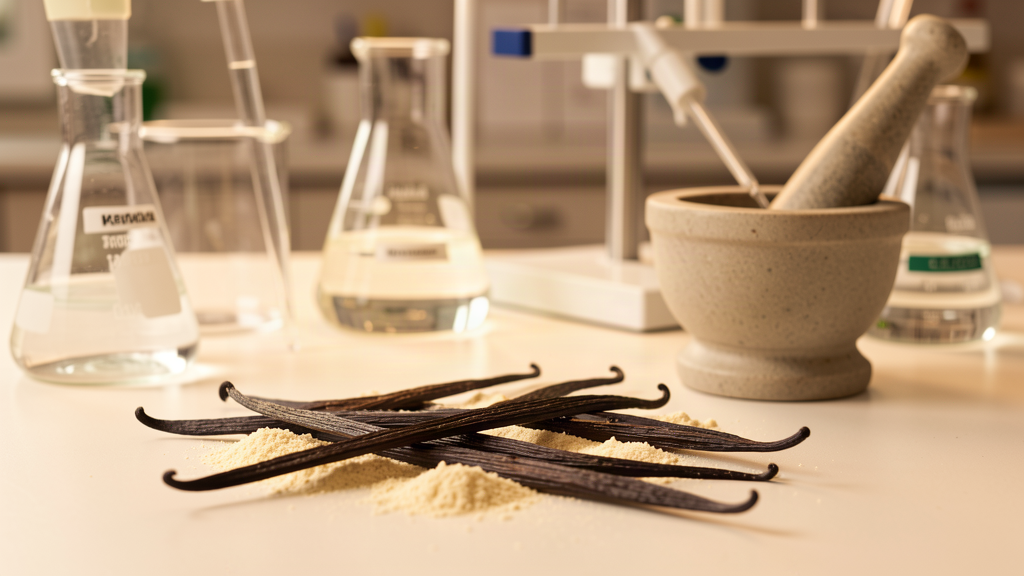
By Monday morning, the paper had already been summarized for you, incorrectly, by someone at your office. Here is what it actually says: vanilla is also medicine.
The compound is vanillin, the molecule responsible for the smell of every birthday in your life. A team at Flinders University in Adelaide, led by Professor Krasimir Vasilev, has documented that vanillin is a pronounced antioxidant, anti-inflammatory, and antibacterial agent, and that it belongs in wound-healing formulations — dressings for chronic ulcers, coatings for tissue regeneration, the boring miracle of bandages that work. The study appears in the International Journal of Pharmaceutics, which is where miracles go to be peer-reviewed.
The finding is not that vanilla is new. The finding is that vanilla was already there. Vanillin is one of the most widely used flavor compounds on Earth, produced from pods and, industrially, from clove oil and rice. It is in ice cream, cola, protein powder, and, as of this research, in the running for the next generation of hospital dressings. The molecule has spent a century doing sensory work and is now applying for a second job.
The lab’s interest in food-as-medicine is, by its own account, an accident that happened to a throat. Vasilev noticed that peppermint leaves from his tea eased a sore throat, and the team eventually built a peppermint-oil-derived nanoscale coating that protects against infection and inflammation while staying compatible with human tissue. Vanillin is the sequel. The research pipeline, in other words, began with a cup of tea, which is how most of medicine began, before medicine got expensive.
Why this matters more than a flavor joke: chronic wounds — diabetic ulcers, pressure injuries — are a massive, unglamorous global burden, and the dressings that treat them are costly. Vanillin is cheap, stable, safe by a century of being eaten, and manufacturable at scale. A wound dressing made from a molecule the food industry already ships by the tanker is not a moonshot. It is a supply chain.
The paper’s framework is called “food-to-function,” which is a grant-committee name for the oldest idea in the pharmacy: the grocery store was the first drugstore, we just stopped making a fuss about it. Ice cream, for the record, still does not heal anything. The powder does. The difference is four hundred dollars a gallon of milk and one Australian lab that read the molecule instead of the dessert.