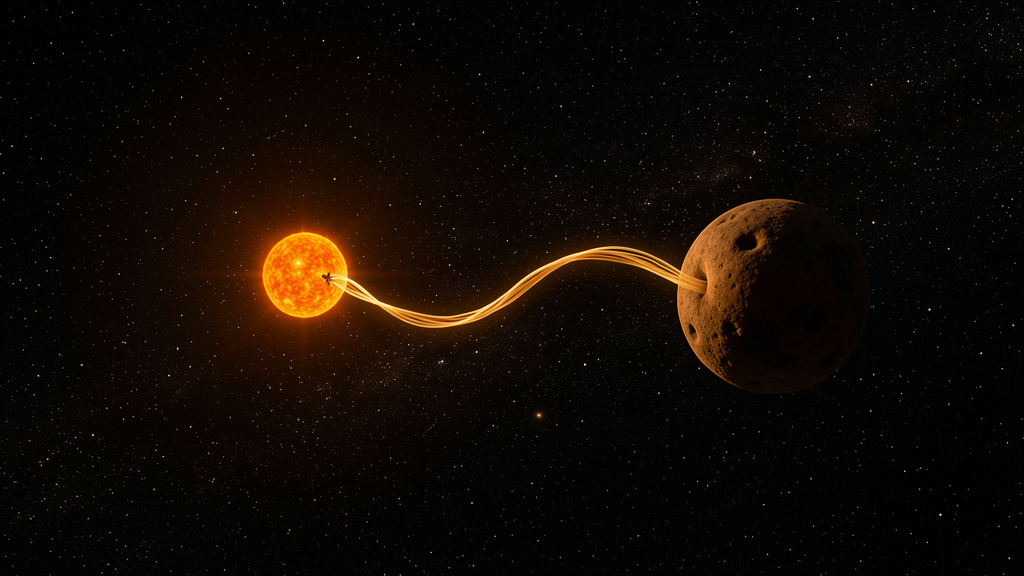
About 300 light-years from Earth, in a system that has the good sense to stay out of the news, a small star is eating its companion, and the scientists who found it describe the process with a word that says everything: gently.
The star, a low-mass sun, has been steadily pulling material off a brown dwarf — a failed star, the cosmos’s term for a star that never quite made it — in a feeding cycle that repeats every 87 minutes and has, per a paper in Nature Astronomy reported by SciTechDaily, likely continued for billions of years. It is the first observation of a low-mass star slowly and steadily consuming a low-mass companion. The narrator considers this a relationship success story and wishes more couples would study it.
By 6 a.m. Eastern, the star has completed roughly 166 meals. By noon, 332. The meals are not large. That is the point. A star that gorges is a star that dies young. This star takes a thin, steady ribbon of gas from its neighbor, the way a person of discipline takes one fry from a shared basket, and it has been doing this since before there were mammals on Earth to be impressed by it.
The brown dwarf, for its part, has never been quoted. It is dim, it is shrinking, and it is, in the specific, dinner. The narrator notes that the brown dwarf chose this orbit, as much as anything in orbit chooses anything, and that the two bodies have been in a stable, mutually defining arrangement for longer than complex life has existed. One gives. One takes. The system holds. Astronomers call this mass transfer. The narrator calls it a marriage, and he is not taking questions.
The discovery was made by a team led by MIT, using the kind of telescope that costs more than most countries, pointed at a patch of sky that looks, to the untrained eye, like nothing. The team found the feeding cycle in the light curve, the wobble that says: something here is being eaten, and it is being eaten on a schedule.
The narrator wishes to address the skeptics, who are already forming. They will say the star is a monster. They will say the brown dwarf is a victim. These people have never held a job, never signed a lease, never watched a roommate eat their labeled yogurt for three years and called it a system. The star is not a monster. The star is an investor. It found a position, it took delivery slowly, and it has not sold.
The system will continue for billions of years. The brown dwarf will keep giving. The star will keep taking. The light curve will keep wobbling every 87 minutes, patiently, for an audience of a few dozen people in Massachusetts who finally learned to read it.
The meal is not over. The meal has never been over.