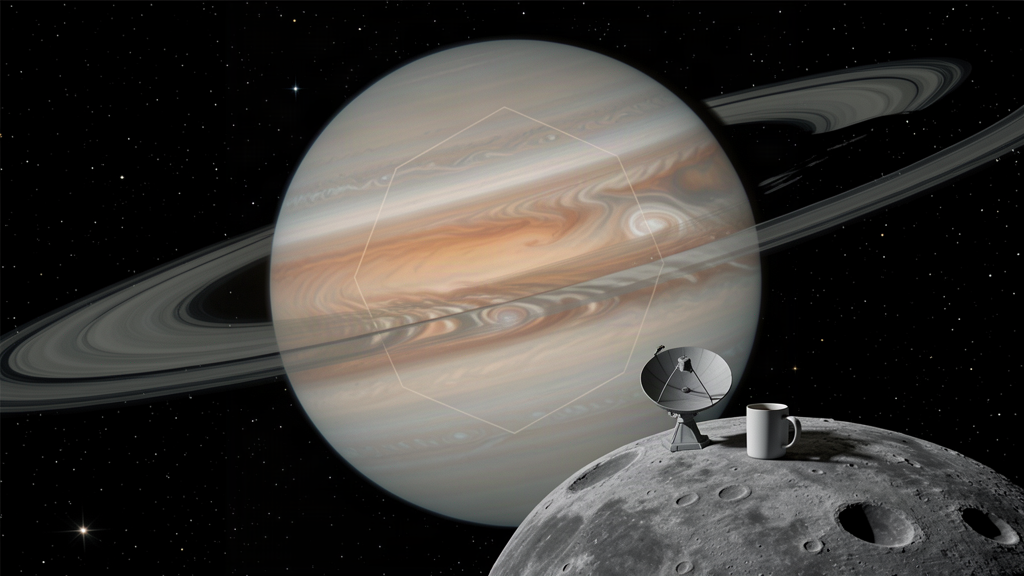
GREENBELT, Md. — Astronomers using the Hubble Space Telescope have identified a ten-sided wave encircling Saturn’s south pole, a shape that is, to put it plainly, a decagon, and that is, to put it plainly, the most regular thing to happen to a planet this year.
The discovery, reported this week, found that the gas giant, which has for decades been known for a hexagon at its north pole, has apparently decided that a hexagon was not enough, and has added a second, ten-sided shape at the opposite end. The two shapes, which extend through multiple layers of the atmosphere, have been described by one astronomer as “a geometric sibling,” a phrase that in the field means “we do not fully understand either one, but we are very proud of both.”
The mechanism, as best the scientists can tell, is a kind of wave, produced when the fast-moving gas away from the poles meets the slower-moving gas closer to them. This interaction, which produces a straight-edged polygon of roughly 104,000 miles across, is the sort of thing that, on Earth, would be called “a breeze,” but on a planet the size of Saturn, is called “a decagon,” and is, by all accounts, very large.
SATURN'S SHAPES: A QUICK RECAP
- The hexagon: A six-sided storm at the north pole, famous for decades, and still, as far as anyone can tell, just there.
- The decagon: A ten-sided storm at the south pole, newly noticed, and already being called "the sibling."
- The planet: Has not commented. It is, as always, very large and very far away.
- The telescope: Did the work, as it does, without being asked, which is the whole point of a telescope.
Skeptics — that is, everyone who has ever looked at a cloud and seen a shape — have noted that a ten-sided figure is, in a gas giant, a very specific kind of shape, and that the fact that it is straight-edged is, as one researcher put it, “the part that is hard to explain,” which is the scientific way of saying “we are making a model, and the model is currently a drawing of a ten-sided shape with a question mark in the middle.”
At press time, the Hubble team confirmed that the telescope is “still doing its thing,” which is the phrase the space program uses when it means “the instrument is working, the planet is large, and the decagon is, as far as we can tell, still a decagon.”