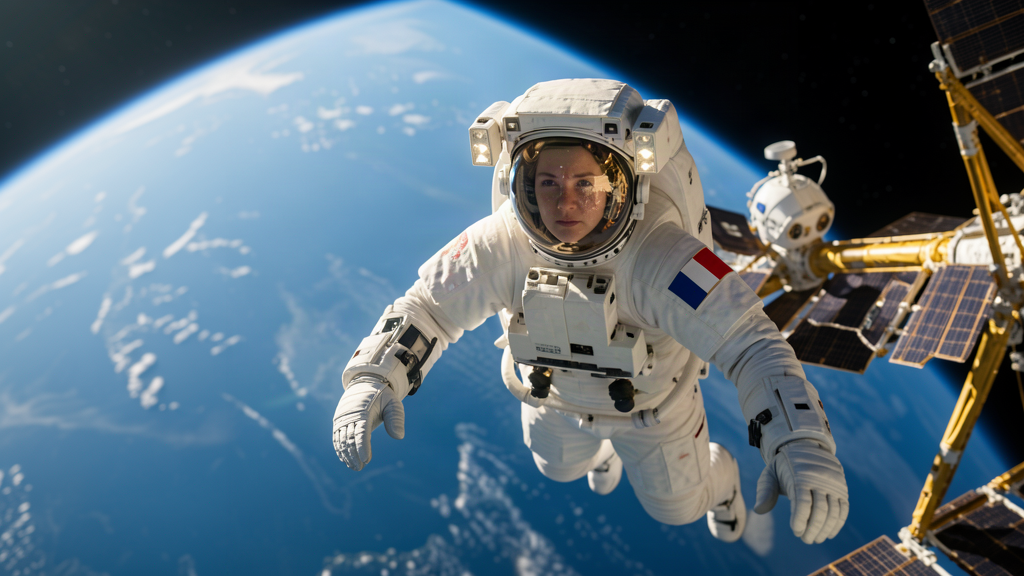
HOUSTON — Early this morning, two astronauts will unclench the hatch of the International Space Station and step into the vacuum, and one of them will be doing something no French woman has ever done.
Sophie Adenot, a former French Navy officer turned astronaut, will become the first French woman to perform a spacewalk, alongside NASA astronaut Anil Menon. The mission — formally designated U.S. Spacewalk 97 — is to replace the space-to-ground communications antenna on the station’s Z1 truss, and it is expected to take about six and a half hours.
Six and a half hours. Let that land. Two humans, roughly 250 miles above the Earth, outside a structure the size of a football field, replacing a piece of equipment that, if it fails, means the station loses its ability to talk to the ground. The Z1 truss antenna is, in the language of the space program, “critical.” In the language of everyone else, it is the phone. France is about to send a woman to fix the phone.
For those keeping score, this is a quiet kind of first. France’s space program has never been loud. The country that gave the world the accordion, the crêpe, and a deeply personal philosophy about cheese has historically had very little to say about the space program, except to point, from a distance, at a thing in the sky and say, in a language that is difficult to hear, that it is doing something. That changes today.
The spacewalk itself is, by the standards of the program, routine, which is the highest compliment the program offers. The two astronauts will spend hours outside the station in what the engineers call “normal operations” and everyone else calls “the part where people die,” replacing an antenna on the truss that extends from the station’s backbone, in a workspace that is, generously, a workspace. Menon, who has done this before, will work alongside Adenot, and the pair will be tethered, gloved, and breathing air that NASA has spent several hours making safe, a process the crew calls “pre-breathe,” which is the most American preparation for a workday imaginable: several hours of sitting very still, being told the air is fine, and then going outside to fix something.
Adenot’s path to the hatch is the kind of path the program likes. A naval officer, a test pilot’s candidate, an astronaut — the résumé reads like a sentence that was written in a hurry and then decided to be true. She will step outside the station for the first time on a morning that, for France, is a first.
U.S. SPACEWALK 97, BY THE NUMBERS
- Astronauts: two. (Confirmed.)
- Time outside: about 6.5 hours.
- Antenna: one. (Z1 truss, space-to-ground.)
- Firsts: one. (French woman.)
- Earth: 250 miles down. (Confirmed by everyone on station.)
At press time, both crew members were in the pre-breathe phase, which means the first French woman to leave the station was, at this moment, sitting in a chair, breathing pure oxygen, and waiting for the most important phone call in the history of French telecommunications.