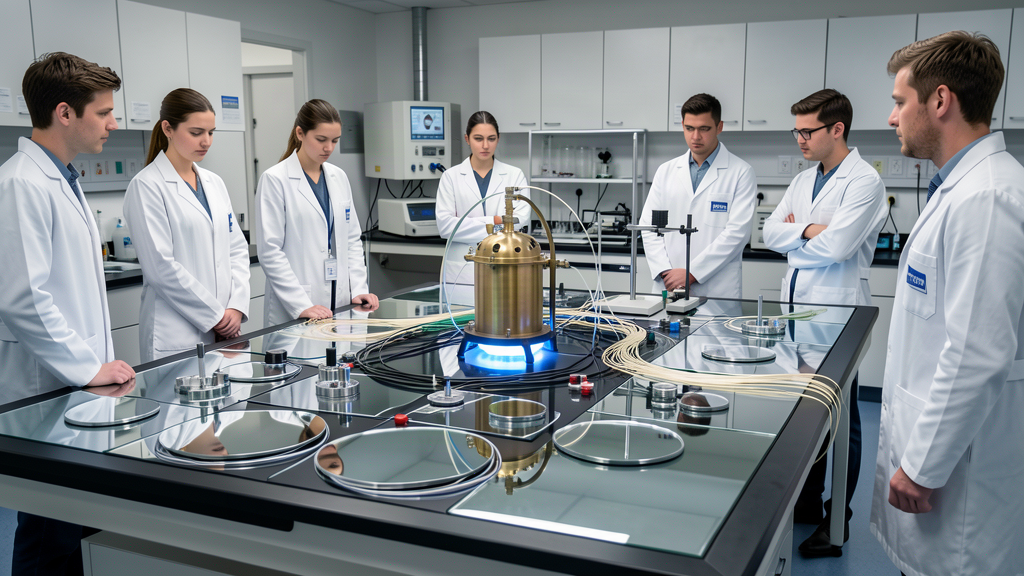
VIENNA — The clock at TU Wien’s Institute of Atomic and Subatomic Physics has been running on its own for more than 24 hours now, which is not remarkable until you learn that every atomic clock on Earth has, until recently, needed a bigger clock to tell it whether it was right.
The Vienna device is the first self-stabilizing nuclear clock. Conventional atomic clocks keep time by watching electrons — the fuzzy outer cloud of an atom — and electrons are, it turns out, easily bothered. A passing temperature change, a stray field, a truck outside the building, and the electron shifts its tune. Nuclear clocks watch the nucleus instead, which sits in the atom’s basement with the door locked and does not care about the weather. This one ticks on thorium-229, the only nucleus in the neighborhood cheap enough to excite with a laser.
We asked Dr. Katharina Brenner, a postdoctoral researcher who was present and has agreed to answer exactly the questions she likes, what the breakthrough means.
Q: Why does the nucleus matter?
A: “The nucleus is shielded. Everything that disturbs an electron — electric fields, magnetic fields, the general noise of being alive — has to get through the whole atom first. It doesn’t. So the nuclear transition is a much quieter bell. A quieter bell means a truer second.”
Q: How true?
A: “Roughly one second of drift in thirty million years. The best atomic clocks are close. But they are close while being constantly corrected by other clocks. Ours corrects itself. It has been doing that for over a day now, unattended, which for a clock is like a car that parallel parks itself while you sleep.”
Q: Will this replace atomic clocks?
A: “Not this year. The prototype is a laboratory instrument the size of a large table. But GPS satellites, telecom networks, and anyone who has ever argued about whose watch is right are the obvious customers. We are not selling watches. We are selling the end of the argument.”
Q: What happens if it stops?
A: “It won’t. But if it did, we would know, because the entire global time system would notice within a day. That is, we admit, slightly stressful.”
Dr. Brenner then asked that we not photograph the thorium sample, because, she said, “it looks like nothing. It is a speck. People expect a reactor.” The speck, as has been well-documented this week, is currently the most honest object in Austria.