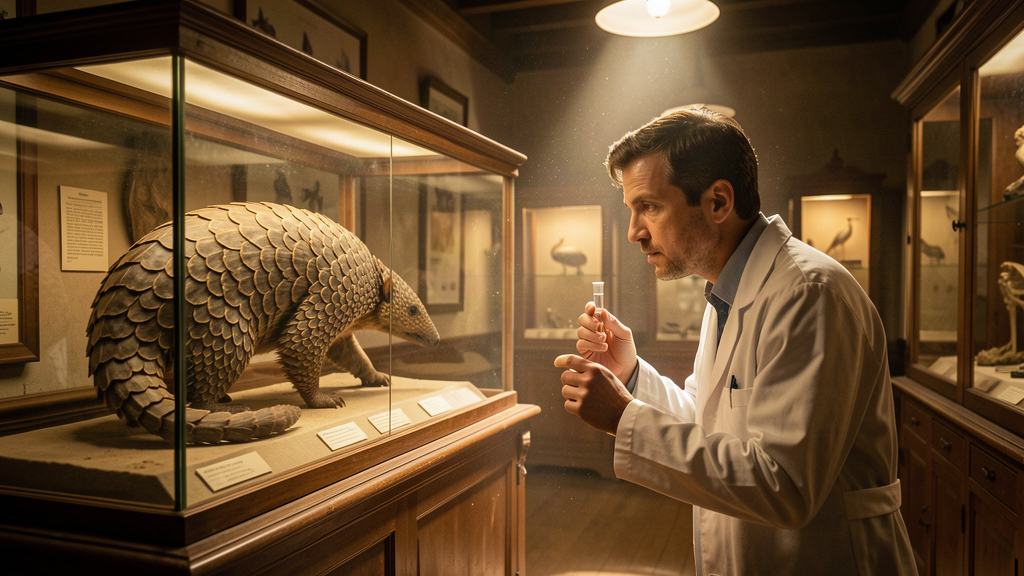
CHICAGO — For 189 years, a pangolin collected in Nepal in 1836 sat on a shelf in a London museum, in a glass case, with a label, looking like exactly what it was labeled as: one of the known species of pangolin. This week, after scientists finally sequenced the DNA from the nearly 190-year-old specimen, the label turned out to have been, in the technical sense, wrong. The animal is its own species.
The discovery, detailed by ScienceDaily on Wednesday, used DNA extracted from the historical type specimen of what had been called the Nepalese subspecies — a specimen that dates to 1836, making it older than the country that collected it. The result is that the Himalayan pangolin, long assumed to be a variant of a better-known relative, is a distinct species in its own right, hiding in plain sight in Nepal and northern India for the entire duration of the time anyone was looking.
The species’ name on the taxonomic record, per the study’s authors, is Manis aurita, and the finding gives conservationists something they have wanted for a long time and never quite had: a reliable genetic fingerprint for a species that is, by the numbers, the most trafficked mammal on Earth. Pangolins are scaled, armored, curled-up, and the specific combination of all three makes them a target on the black market, where the scales are sold and the meat is eaten, which is to say the species has been under pressure for exactly as long as anyone has been able to buy it.
The method is the part of the story that should get the headline. Museum specimens — the dried, pinned, stuffed, and otherwise preserved collections that fill the basements of natural history institutions — are generally regarded as an archive, a record of what was known when it was known. What the pangolin case demonstrates is that the archive is also a library, and the library has books in it that no one has finished reading. Ancient DNA, degraded and fragmented as it is, can still carry a species’ identity across nearly two centuries, which means the collections of the world, which hold hundreds of millions of specimens, are also a genetic database of a scale that has no other.
THE SHELF, AT A GLANCE
- Collected: 1836, in Nepal, by a person whose name is on a label no one had thought to read carefully.
- Stored: A London museum, glass case, approximately one pangolin per case, 189 years running.
- Sequenced: This week, by a team that includes researchers at the Field Museum in Chicago.
- Result: A distinct species, *Manis aurita*, confirmed, with a genetic fingerprint conservationists can use to trace illegally trafficked scales back to a specific population.
- Next: Everyone else on the shelf. The collections have specimens. The specimens have DNA. The DNA has opinions.
The practical consequence is the one that matters. Trafficked pangolin scales, once they are out of the wild, are a commodity with no paper trail, and the paper trail is the thing that prosecution needs. A confirmed species with a known genetic signature means that a seizure of scales can now be matched to a region, which means the trade can be followed to the source, which means the people who collect and sell the scales are now, in the words of one of the study’s authors, “a lot easier to point at with a fingerprint.”
At press time, the museum where the specimen sat had not announced whether the label would be corrected, which is a question the institution is, by the look of the room, taking seriously. The pangolin, for the record, is still in the case. The case is still on the shelf. The shelf, per a curator, is “holding up beautifully,” and the curator is, on the record, “proud of the work.”