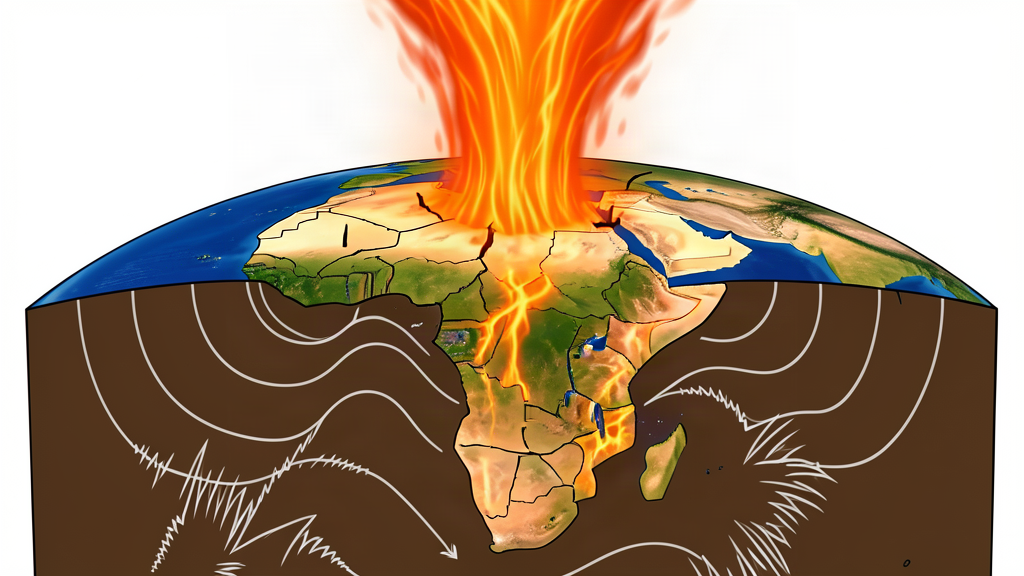
NAIROBI — Scientists have, for the first time, identified the thing under Africa that is, in the specific, pulling the continent apart, and the thing is a plume, and the plume is, in the specific, enormous, and the plume has been, in the specific, doing this for a long time, and the plume is, in the specific, not going to stop.
The finding, published this week, points to what the researchers are calling the African Superplume: a vast upwelling of hot rock rising from deep inside the Earth, from the boundary between the mantle and the core, and pushing up against the underside of the continent. The plume is responsible, the researchers say, for the unusual motion that runs parallel to the East African Rift, and for the matching pattern in the way seismic waves travel through the rock, which is the way scientists describe what they mean when they say the ground is moving in a direction that the conventional model did not account for.
The East African Rift is, in the specific, the largest continental rift on Earth, and it is, in the specific, a crack in the continent that has been, for millions of years, slowly getting longer. The conventional explanation for the crack was that it was being pulled apart by tectonic forces, the same forces that move the continents, and the new finding is that it is, in the specific, also being pushed from below, by the plume, and that the pushing is, in the specific, doing more of the work than the pulling.
The word the researchers use for the plume’s behavior is “pulses,” which is the way a geologist describes what a heart does, and the plume, in the specific, does it. The pulses carry, per the lead author, distinct chemical signatures, which is the way the plume tells the researchers where it has been, and the chemical signatures are, in the specific, the equivalent of a fingerprint, and the fingerprint is, in the specific, on the rock, and the rock is, in the specific, on the surface, and the surface is, in the specific, where the people live.
The practical implication of a continent being pulled apart from below, by a plume that is, in the specific, pulsing, is that the crack is, in the specific, going to keep getting longer. The East African Rift is, in the specific, going to become, over the course of tens of millions of years, a new ocean, and the plume is, in the specific, the thing that is going to make that happen, and the plume is, in the specific, not going to be consulted.
THE SUPERPLUME, AT A GLANCE
- What it is: a vast upwelling of hot mantle rock, from near the core
- What it's doing: pushing the East African Rift open from below
- How it moves: in pulses, with distinct chemical signatures
- The result, eventually: a new ocean, over tens of millions of years
- The consultation process: none
The researchers used advanced computer simulations to reach the finding, which is the way modern geology works: you cannot, in the specific, put a thermometer in the mantle, so you build a model, and you run the model, and you look at what the model does, and you compare the model to the seismic data, and if the model matches the data, you publish, and if it does not, you build a better model, and you do this, in the specific, for a career.
At press time, a geologist not involved in the study said the finding was “consistent with what we’ve long suspected,” which is the way a scientist describes a result that confirms a hunch, and the hunch, in the specific, is that the ground under Africa is, in the specific, moving, and that the movement is, in the specific, going to continue, and that the plume, in the specific, is not going to be stopped.