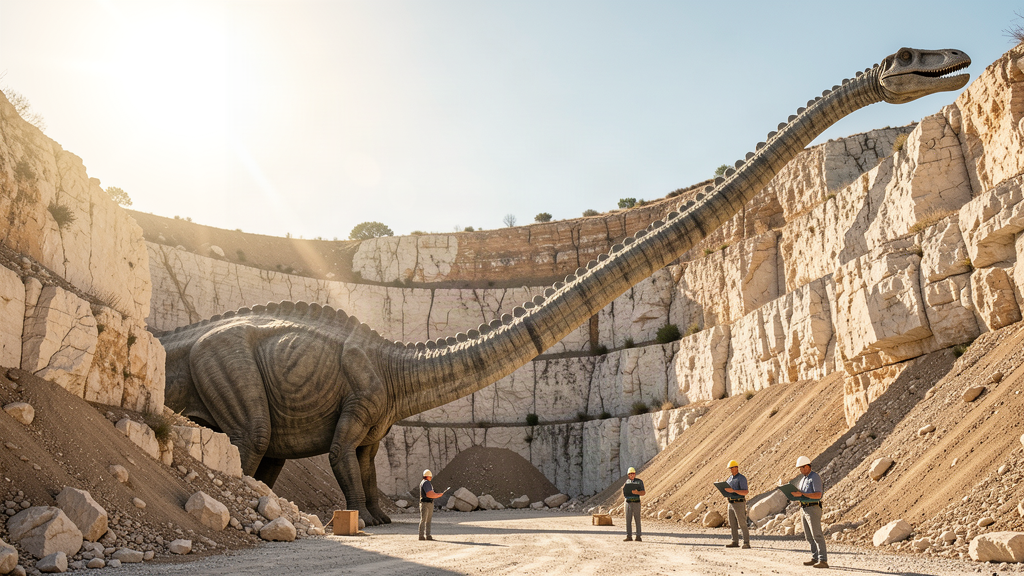
EL CASTELLAR, SPAIN — The Diplodocus, it turns out, was never actually a North American dinosaur. It was a North American dinosaur that had, until last week, been assumed to be a North American dinosaur, and the assumption was so long-standing that no one had thought to check the rest of the map. A 150-million-year-old fossil from the La Tejería site near Teruel in Spain has been identified as the first confirmed Diplodocus ever found outside North America, and the discovery has done something that only a dinosaur can: it has made the entire field of paleontology slightly re-organize itself.
The animal measured about 25 meters long and was preserved well enough for researchers at Fundación Dinópolis to match the bones — fourteen tail vertebrae and several chevron bones, among others — to the genus with the confidence of people who had been looking for it in a very specific set of states for over a century. ScienceDaily reports the find as a reshaping of the Late Jurassic migration picture. The team, in a companion writeup, called it the first confirmed fossils of the genus ever discovered in Europe.
The joke, if it is a joke, is that the joke is the map. For a century and a half, the Diplodocus has been drawn in museum dioramas standing in exactly the same place, in exactly the same formation, with exactly the same little sign that says MORRISON. The Morrison Formation. A fossil site spanning several states in the United States. The dinosaur was so thoroughly American that finding it in Spain feels less like a discovery and more like a correction — the kind you make to a friend who has been repeating a fact you have quietly been carrying the erratum to for some time.
The implication is the part the papers are being careful to underline. A Diplodocus in Spain is not a Diplodocus that took a trip. It is evidence that the animal, or its close relatives, were more widespread across the Late Jurassic landscape than the single-formation model allowed. The migration picture, the researchers say, now has to account for a long-necked, long-traveled, long-suffering creature that crossed a land bridge that, at the time, was the entire planet.
THE DIPLODOCUS, AS UNDERSTOOD, AND THE DIPLODOCUS, AS FOUND
- Length: approximately 25 meters
- Age: approximately 150 million years
- States previously checked for the genus: all of them (the relevant ones)
- Countries previously checked: 1
- Countries now checked: 2
- Confidence in the identification: "high enough"
At press time, the fossil had been identified, the migration picture had been redrawn, and a researcher on the team, asked what they would look for next, paused in the way that only a paleontologist can. “Well,” the researcher said, “we had assumed it was a North American dinosaur.” The pause, which lasted about four seconds, contained the entire history of the next ten years of the field.