URBANA, ILL. — By 7 a.m. Monday, the city had confirmed that preparations for Friday the 13th were proceeding, and that as of this morning nothing about November 13 had been canceled.
Eleven days from now, the date arrives: the official end of the human race, as forecast in a celebrated 1960 paper in Science by University of Illinois physicist Heinz von Foerster and his students, which observed that the time required for the world’s population to double kept shrinking — 127 years for one doubling in the 19th century, 47 for the next — and concluded that if doubling times keep shrinking, population reaches infinity, and everything gets tight.
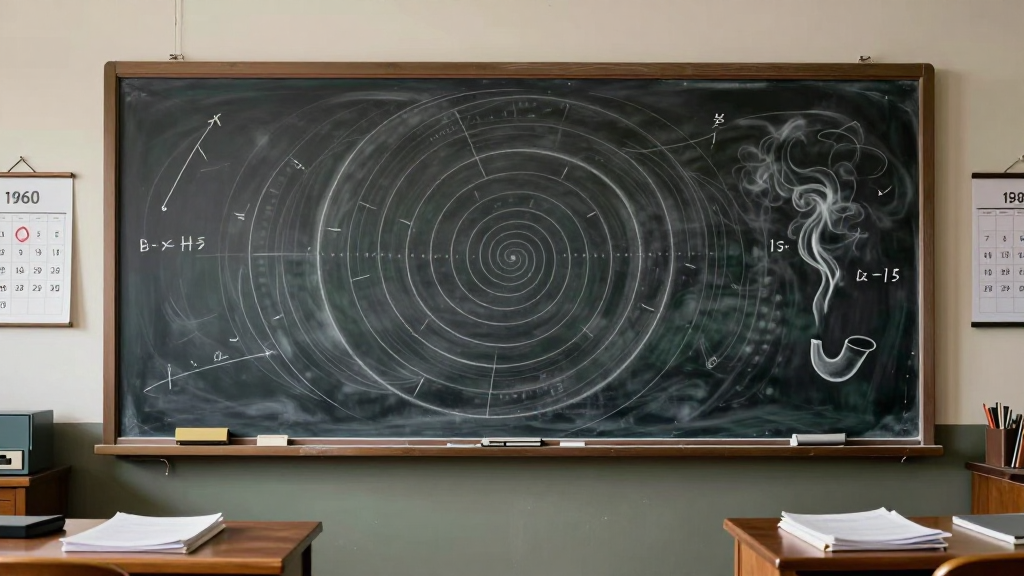
By 9 a.m., the department of physics had removed from service, with honors, the chalkboard version of the equation, in a small ceremony attended by four people and one reporter who had been told it was a storage cleanup. The paper’s famous line was read aloud. It is worth reading twice, because it is the calmest way anything has ever been said about the last day:
By 10:30 a.m., demographers across the country were once again explaining, patiently, that the world did not end this Friday and that the reason is almost embarrassing in its decency. The formula assumed the doubling would continue. Instead, birth rates fell — first where women gained schooling and work, then nearly everywhere else — and the population curve that was supposed to vertical now leans. The world population is about 8.3 billion, and the anxiety among serious demographers is now that there will be too few people, not infinitely many. The model failed the way the best models fail: by being a faithful description of a world that grew up.
By noon, the academic response machine had reached full capacity. The Complexity Science Hub in Vienna is holding a conference on November 13 titled, with the straight face of an institution that has never not held a conference, “On the Sense and Nonsense of End-of-the-World Predictions.” There will be panels on doom forecasting. The keynote hour overlaps the original doomsday.
DOOMSDAY BY THE NUMBERS
- 1800: world population passes one billion. The first doubling takes 127 years.
- 1927: two billion. The second doubling takes 47 years.
- 1974: four billion. Five billion follows just 13 years later. Von Foerster's paper is already 14 years old.
- Nov. 13, 2026: the date the shrinking doubling times, carried honestly to their conclusion, produce infinity.
- Today: 8.3 billion and slowing. The doubling time, quietly, stopped shrinking.
By 2 p.m., a physicist at the institute, speaking on condition of being quoted, said the paper remains one of the most beautiful wrong predictions in science, and that wrongness is not the same as worthlessness. “We did the math correctly,” he said. “The population did the other thing. That is a good outcome for a model — the model was fine, the world improved. Nobody writes grant proposals for a world that improves.”
He then said the thing the demographers have been saying all week, which is that there is no candlelight vigil for a fertility transition, no ticker crawl for the statistic that saved the 21st century, and no action figure for the unglamorous global decision of couples to have two kids instead of five. The apocalypse was averted not by heroics but by the diffusion of education and a general sense that houses were getting smaller.
By 4 p.m., the city’s public works schedule was confirmed unchanged: trash pickup continues on the 13th, at regular hours, and the roads will be open.