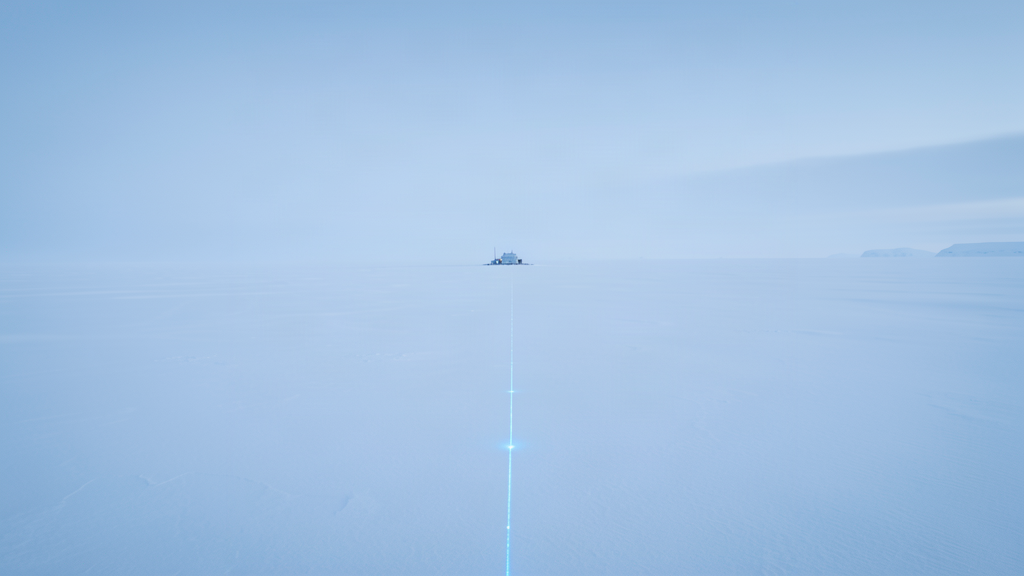
MADISON, WISCONSIN — The Royal Swedish Academy of Sciences on Tuesday awarded the Nobel Prize in Physics to Francis Halzen, a physicist who looked at the South Pole — a place already famous for having nothing in it — and said, with a straight face, “what if we used all of that ice to take a picture of the universe,” and then, against all odds and all common sense, did exactly that.
Halzen received the prize “for decisive contributions to the IceCube Neutrino Observatory,” which the committee, in its citation, described in the plainest possible terms as a cubic kilometer of ice equipped with light sensors, a sentence that reads like a dare and functions as the largest scientific instrument ever built.
The premise is this. Neutrinos are particles that come from space, pass through the Earth without noticing it, and are nearly impossible to catch. Halzen’s idea, first proposed in 1988, was to bury thousands of light detectors under the ice at the South Pole and wait for one of the particles to, very rarely, bump into something and flash. The ice is the camera. The South Pole is the tripod. The universe is the subject, and it is, by all accounts, a difficult sitter.
“Some say you cannot build a telescope out of a continent,” said Dr. Lena Voss, an astrophysicist who did not build one. “Others say you can. The truth, as always, lies in the ice, where for years the answer was simply a very expensive hole.”
To construct the observatory, engineers melted 86 holes two and a half kilometers deep into the glacier with hot-water drills, lowered strings of sensors into the water like, as one description put it, an oversized string of Christmas lights, and then let the holes freeze shut, sealing the equipment inside the ice forever, a decision that engineers describe as “irreversible” and that the public describes as “a lot.”
The payoff came in 2013, when IceCube detected high-energy neutrinos arriving from beyond the solar system, the first confirmed sighting of ghostly particles from deep space, proof that a man with a theory and a hot-water drill can, in fact, take a picture of a black hole’s bad day.
THE ICECUBE, BY THE NUMBERS
- Volume: One cubic kilometer of ice, the largest detector in human history and the only one made of a frozen continent.
- Depth: 2,500 meters, melted with hot water and then allowed to refreeze, sealing the equipment in permanently.
- Sensors: 86 strings of 60 light detectors each, lowered into the ice on cables.
- Hit rate: A handful of usable neutrinos per year, out of trillions that pass through, which is a batting average that would get a position player sent down to the minors.
At press time, Halzen, reached at the University of Wisconsin, said he had not yet decided what to do with the prize money but was “thinking about ice,” a remark his colleagues confirmed he has made, in some form, every day since 1988.