SANFORD, SOUTH DAKOTA — For decades, the story of the universe has had a problem, and the problem is that the math does not add up. We can see all the matter in the sky. We can weigh it, in a sense. And when we add it all up, it comes out to about a fifth of what the universe should contain. The rest is not there. It does not reflect light. It does not absorb it. It is not, as far as we can tell, made of anything we have ever put our hands on. It is called dark matter, and it is the single largest missing item in the accounting of everything.
A team of two hundred and fifty scientists from thirty-nine institutions across six countries has now reported that it saw something, in a finding announced at a conference in Japan. Not a lot. Not a pattern. One thing. A single particle interaction, recorded in a detector nearly a mile underground in South Dakota, that might have been caused by a particle of the kind that dark matter is supposed to be made of. Or it might not have. The scientists are, by their own description, “incredibly excited,” and also, by their own description, not claiming to have seen dark matter.
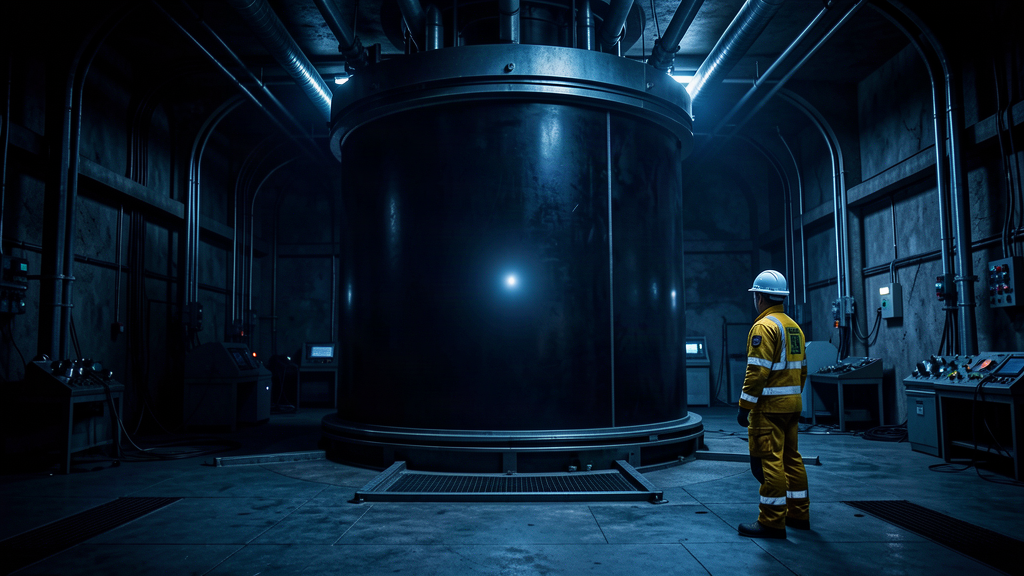
The detector is called LUX-ZEPLIN, and it is one of the most sensitive machines on Earth. It sits in the Sanford Underground Research Facility, the deepest laboratory in the United States, where a mile of rock sits between it and the cosmic noise of the sky. For two years, the team scrutinized its data. And in all that data, they found one event. One. That did not look like the background. That did not look like any of the things they had already explained.
That is the whole finding, and it is the story, and the honesty of it is what makes it remarkable. The scientists have rated their own evidence at something called 2.6 sigma, which is a number that means “we saw something, and we are not sure it is what we think it is.” The threshold for a discovery in this field is five. They are at 2.6. They are, in the language of the field, “interesting,” which is the most important word in the sentence.
Professor Rick Gaitskell, of Brown University, put it plainly. He said the team had done “a huge amount” of work to rule out every previously known explanation for the event, and that “to date none provide a convincing explanation.” That is not a claim of a discovery. That is a claim that a mystery is, for now, a mystery, and that the mystery is the thing worth sharing.
THE FINDING, BY THE NUMBERS
- One particle interaction, in two years of data.
- 250 scientists, 39 institutions, six countries.
- The detector sits nearly a mile underground in South Dakota.
- Statistical significance: 2.6 sigma. The discovery threshold: 5.
- The event "does not provide a convincing explanation" — yet. Which is the point.
It is worth pausing on what it would mean if this is the real thing. Dark matter is not a rare object. It is not a particle you would find on a shelf. It is, by every measurement, the majority of the mass in the universe. It is the stuff that holds galaxies together, the invisible hand that keeps the stars from flying apart. We have never touched it. We have never seen it directly. We have, for a long time, inferred it the way you infer a person in a dark room by the way they move the furniture. This would be the first time, in the history of the measurement, that the furniture moved, and we are not sure who was holding it.
The team has presented the result at a conference and is now waiting for the rest of the scientific community to look at the one event and tell them, with the full weight of its skepticism, whether the one event is a thing or a fluke. That is how the field works. One event is not a discovery. One event is a request for more data, and for someone else to try to be wrong about it.
At press time, the team said it was “waiting to analyze more data to see if additional candidate events appear.” That is the whole future of the finding in one sentence: they are going to look for a second one. If there is a second one, the conversation changes. If there is not, the furniture has moved one time, in a dark room, and we will have to wait for it to move again. For now, the universe has, for the first time, given us a reason to pay attention to the quiet.