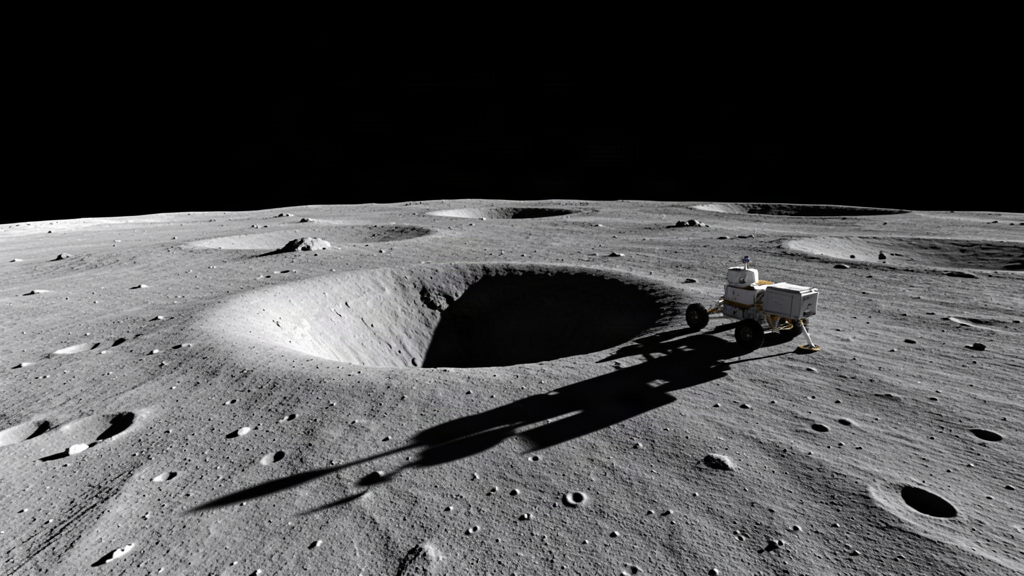
The Moon has a hole in it. NASA saw the hole in 2009, from orbit, and the hole has now been on the to-do list for seventeen years, which is how long it takes a space agency to say: fine, we’re going.
The hole is called the Marius Hills Pit. It is a collapse feature — a skylight into a lava tube, a tunnel left behind by an ancient river of molten rock that drained out and, in doing so, may have left one of the largest empty rooms in the solar system. NASA selected the GIMLI project on October 1 to send ground-penetrating radar, seismic sensors, a gravimeter, and cameras to the pit’s rim, to look under the floor of the Moon and estimate the size of the room.
It will be the first intentional seismic survey on the Moon since Apollo 17 in 1972. The last time humans listened to the Moon’s insides, the equipment was left behind by astronauts who drove a rover on it.
The plan, per the Planetary Science Institute, which leads the proposal, is to park the instruments near the pit, ping the ground, and read the echoes. If the lava tube is real and large, the data will show it. If the tube is stable, the room is a candidate for the future housing of astronauts, who, it turns out, would prefer not to live in a tin can on a surface that gets hit by rocks all day. A lava tube has a roof. A roof is the most underrated word in space exploration.
The narrator has covered a lot of mission press conferences, and the GIMLI briefing had a tone the narrator can only describe as “checking on the kid at college.” The hole has been down there the whole time. We saw it. We have been putting off the visit. The instruments are packed.
The mission will fly on a commercial lunar lander under NASA’s PRISM payload program, on a schedule the agency describes, as agencies do, as “no later than” a year that is a number.
The pit is 45 meters wide. The room under it, if it is a room, may be a kilometer long. The Moon has kept it for a billion years. It can keep it a few more months.