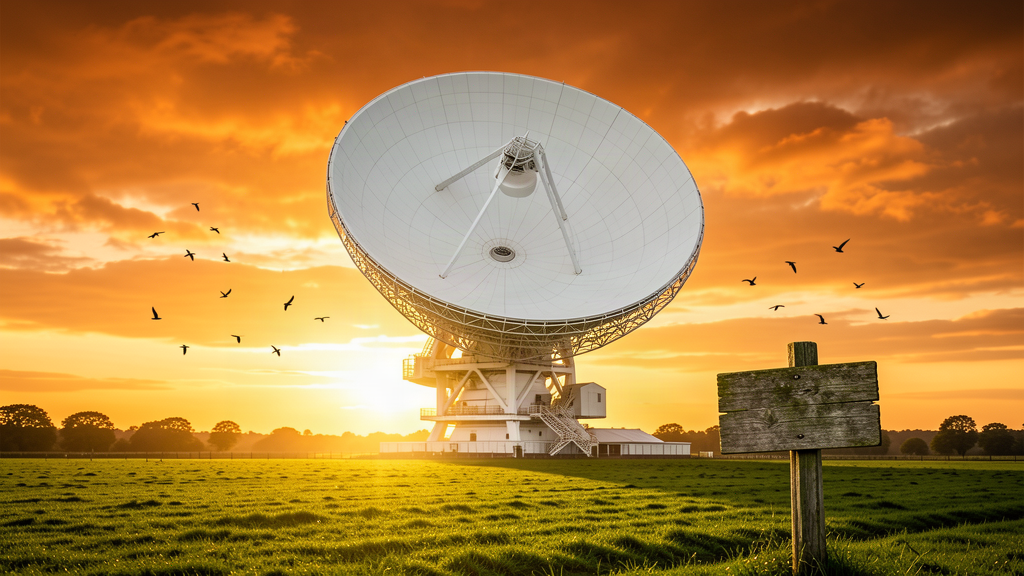
MANCHESTER, ENGLAND — The Lovell Telescope, the 250-foot dish at Jodrell Bank that has been listening to the universe since 1957, is losing its government funding, and while the world’s astronomers are “up in arms,” as the headlines put it, I am here to ask the question no one in science wants to answer: what, exactly, has the universe ever done for Britain?
The U.K. Research and Innovation funding body announced it will no longer fund the Lovell telescope, whose giant parabolic bowl is a Grade I-listed local landmark, as part of a revamped funding model that prioritizes “economic growth and measurable outcomes.” Funding was also terminated for projects including a future CERN experiment. And you know what? It is about time someone did a cost-benefit analysis on space.
Consider the Lovell Telescope’s track record. Since 1957, it has tracked Sputnik. It has discovered pulsars. It has listened for signals from the far reaches of the cosmos. And in all that time — 69 years — it has never once sent an invoice. Not one. The telescope has been providing free long-distance service to the universe, and the universe has been getting away with it. You do not have to be a bean counter to see that this arrangement was unsustainable. You just have to be the first bean counter brave enough to say it.
The scientists are, of course, furious. They say the telescope is irreplaceable. They say it is a world-leading facility. They say cutting it will harm Britain’s global standing. But here is what the scientists won’t tell you: the scientists are the ones who benefit from the free cosmic service. They have been riding the universe’s network for free since before the internet existed, and now that the bill has arrived, they are complaining about the service. Typical.
The new funding model is simple and it is fair: if it does not grow the economy, it does not get funded. And what has the Lovell Telescope grown? A field. Some grass. A few prize-winning pumpkins in the visitors’ car park, which, to be fair, is more than most government programs can claim. Pulsars, meanwhile, do not pay taxes. Quasars do not shop locally. The Andromeda Galaxy has never once purchased a British product. The universe is, and I say this with the deepest respect, a freeloader.
THE LOVELL TELESCOPE: 69 YEARS OF UNCOMPENSATED LABOR
- 1957: Tracked Sputnik. Billed Sputnik: nothing.
- 1967: Discovered pulsars. Charged pulsars: no royalties.
- Total revenue generated: £0. In 69 years.
- Total cosmic entities billed: 0. The universe has never once been asked to pay its way.
- Measurable outcomes: One field of prize-winning pumpkins, and growing.
- Time spent waiting for a thank-you note from the universe: 69 years and counting.
The future, however, is bright. Once the funding ends, the 250-foot bowl will be repurposed as the world’s largest birdbath, which will generate the kind of measurable outcomes economists can finally get behind: measurable bird activity, measurable water evaporation, and measurable local employment for the people who will have to clean it. It is the most economically sound use of a giant concrete bowl in the history of the United Kingdom.
At press time, the universe had been notified of the funding decision and was said to be “reviewing its options,” possibly by emitting a series of radio pulses — which the telescope, of course, will no longer be listening for.