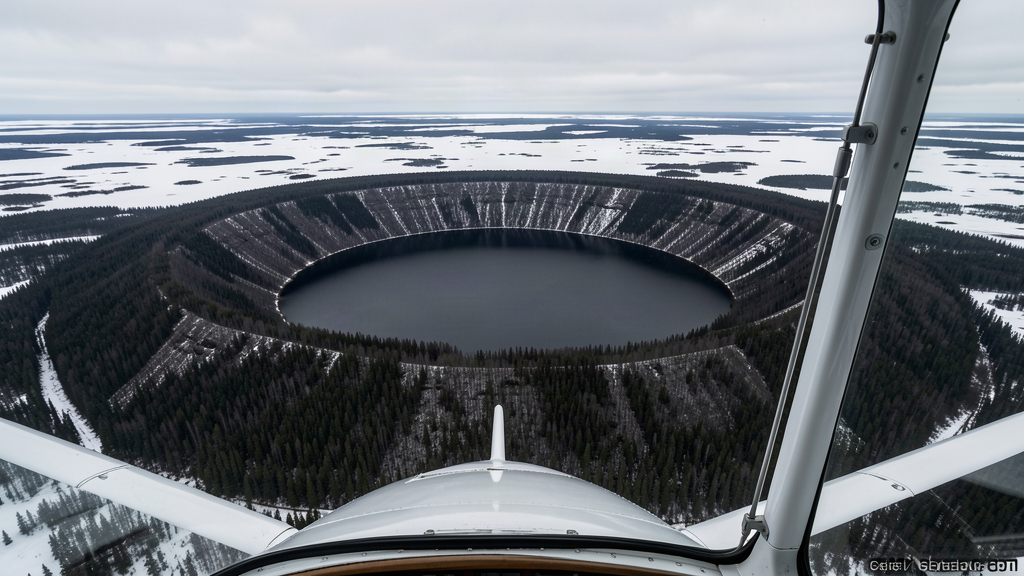
LAVAL, Quebec — A man who was, in the specific, looking for a place to camp has, in the specific, found a hole the size of a small country, which is the discovery a person makes when the person is, in the specific, looking for a campsite and the campsite, in the specific, is, on the record, the discovery.
The man, an amateur astronomer named Joël Lapointe, was planning a camping trip in Quebec’s Côte-Nord region in 2024 and scrolling through satellite imagery when he noticed a nearly circular pattern of ridges hugging a body of water, which is the thing a man sees when the man is, in the specific, looking for a tent and the tent, in the specific, is, on the record, a ring.
The ring, it turns out, is a crater. A 25-kilometre-wide impact crater, roughly 390 million years old, now provisionally named Uhackatik, a name the geologists have given the hole because the hole, in the specific, needed a name, and the name, in the specific, is, on the record, the hole.
"I was looking for a place to sleep. I found a place that was, in the specific, hit by a rock. The rock, in the specific, did not have a reservation, but it has, on the record, a crater." That line is from Lapointe, who said he reached the ring the following year by floatplane, which is the way a man gets to a discovery when the discovery is, in the specific, a ring in a place where the ring is, in the specific, the only thing, and the floatplane, in the specific, is, on the record, the way. The geologists, in the specific, found shatter cones, which is the word the science uses for a rock that has, in the specific, been hit, and the hit, in the specific, is, on the record, the rock, and the rock, in the specific, is the crater. For the campsite, which is, in the specific, now also a scientific site, the discovery restores a status the hikers describe as a view and that the geologists describe as a structure, which is why, when the confirmation was published, the question on everyone's mind was not whether the ring was a ring but whether the ring would, in the specific, remain a place to sleep. A geologist, asked about the crater, said it was "one of the largest unrecognized impact structures in the region," which is the phrase the science uses for a hole that was, in the specific, there for 390 million years and was, in the specific, unrecognized, and the unrecognized, in the specific, is, on the record, the 390 million years.The wilderness, for its part, appears to be on the record. The ring, in the specific, has been confirmed, the name, in the specific, has been given, and the campsite, in the specific, is, on the record, the crater, which is the three-part answer the hole gives when the hole is, in the specific, also a place to sleep. At press time, the crater was, in the specific, named, the floatplane was, in the specific, grounded, and the man was, in the specific, looking for a tent, which is the word the man uses for a place to sleep that, on the record, is, in the specific, a hole.THE CRATER, IN THE GEOLOGIST'S OWN WORDS
- The width: 25 kilometres. The number, in the specific, is the width of the ring, and the ring, in the specific, is the width of the campsite.
- The age: 390 million years. The number, in the specific, is the age of the hit, and the hit, in the specific, is, on the record, the age of the hole.
- The name: Uhackatik. The word, in the specific, is the name the geologists gave the ring, and the ring, in the specific, is, on the record, the word.
- The method: Satellite imagery, followed by a floatplane. The method, in the specific, is the way a man looks for a campsite, and the campsite, in the specific, is the way a man finds a crater.