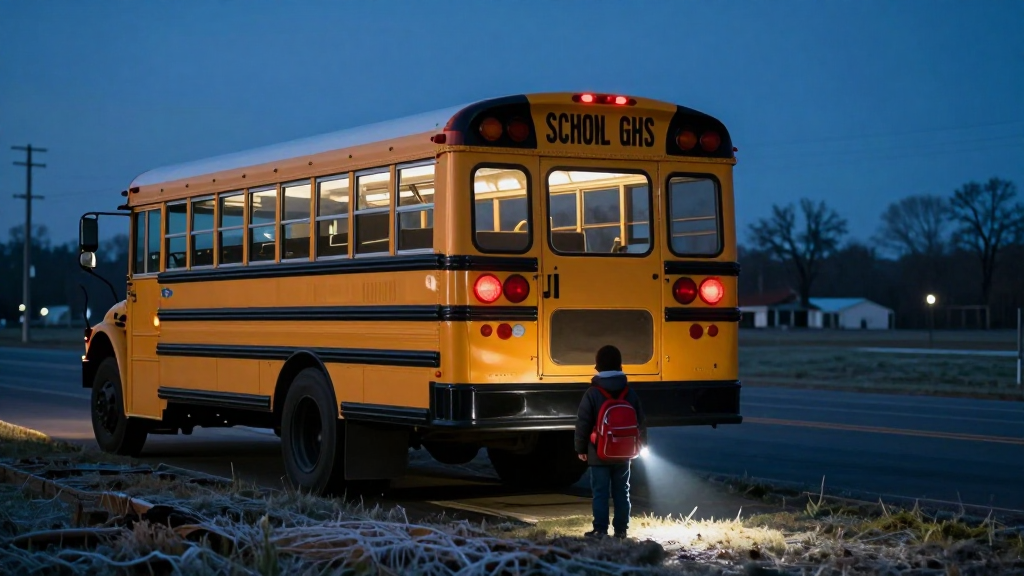
Last Sunday, the clocks fell back in the United States, and the country returned to standard time for the winter. This is the brief backdrop, and now the number.
Researchers at the University of Washington have calculated that permanently adopting daylight saving time would force at least 2 billion additional dark-morning school commutes on American children every year, from November through March. Two billion. That is a number large enough to stop being a number and start being a neighborhood, repeated.
The estimate, published in Current Biology on Tuesday, is what scientists call a floor. The authors are careful to note their count may substantially underestimate the real impact, which is the polite scientific way of saying the real number is bigger and they did not want to alarm anybody.
THE MATH
The work came out of the kind of patient accounting that makes a country proud. Under the Sunshine Protection Act proposal, a child in the eastern half of a large time zone could board a bus in blackness that under standard time would have been, at most, gray. The difference, multiplied by six months and by every child with an early bell, is the two billion. It is precise, audited, and on the record, in the way that only an official figure pronounced twice can be.
“The commute math was the easy part,” said Dana Whitlock, a University of Washington graduate student who spent a semester on the spreadsheet and whose mother has since asked her to stop bringing the spreadsheet home. “You count bus stops, you count start times, you count the sun. The sun cooperates. It is the one contributor that has never once presented me with an excuse.”
THE MUNDANE
On the ground, the figure has a human shape and a flashlight. Bob Hanrahan, a school bus superintendent in the Pacific Northwest, said he has watched enough dark bus stops to believe any number you put in front of him. “I was against it before there was a study,” he said. “Now there is a study, and there are two billion of something, and I was against it before, so we agree.”
A seven-year-old in third grade, interviewed gravely by this correspondent and quoted with the full weight of a national figure behind her, put the matter in its clearest form. “The dark is fine,” she said. “It is the cold that is the insult. The bus has a heater. Welcome, I guess, to the bus.”
Chronobiologists, for the record, have argued for months that sunlight in the morning matters to sleep, to attention, to the small machinery that keeps a third grader upright. The study now gives that argument a denominator. It has given it a number at which meetings are scheduled and memos are written, and it has delivered that number to a nation that just set its clocks back and is currently receiving darkness at a rate it will now be able to calculate.
The study’s authors estimate that on any given school morning in the affected months, approximately 840,000 additional American children are standing at a bus stop in full dark — a figure, they add with precision, that does not count the cold.